
Guiding the Gaze: A Comprehensive Obstruction Lighting Guidance for Modern Airspace
The modern skyline is a testament to human ambition—towers that scrape clouds, wind turbines that harvest the jet stream, and bridges that span impossible distances. Yet, for the aviator threading through this vertical labyrinth, each structure represents a potential hazard. Obstruction lighting guidance serves as the essential manual for mitigating these risks, transforming invisible threats into unmistakable warnings. This guidance is not merely regulatory paperwork; it is the accumulated wisdom of decades of aviation safety, distilled into actionable protocols that save lives daily.
The foundational premise of obstruction lighting guidance rests on a simple truth: if a structure exists, it must be seen. The International Civil Aviation Organization, through Annex 14, provides the global framework, while regional authorities like the Federal Aviation Administration and the European Aviation Safety Agency adapt these principles to local airspace dynamics. The guidance categorizes obstacles based on height, location, and surrounding terrain, prescribing specific lighting configurations that range from steady-burning red beacons to high-intensity white strobes. A 150-meter transmission tower in flat farmland demands different treatment than a 50-meter chimney adjacent to a major airport approach path.
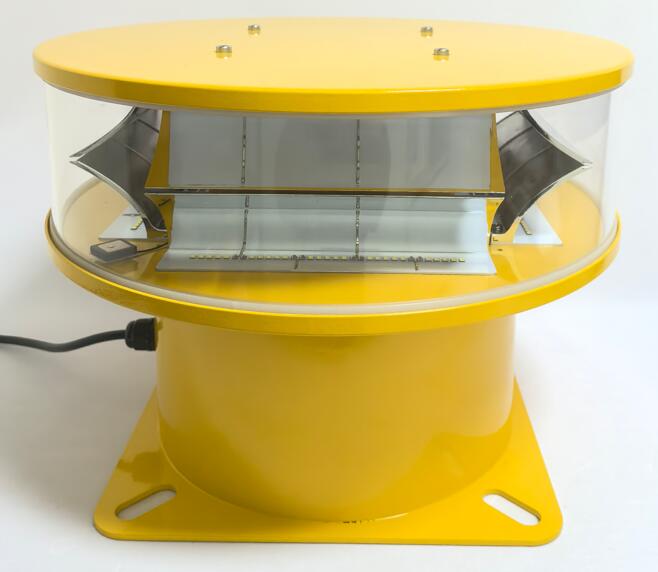
Understanding the guidance requires grasping the concept of "airspace penetration." Any object that intrudes into the protected surfaces surrounding an aerodrome—the approach slope, the transitional surface, or the horizontal plane—triggers lighting requirements. These imaginary surfaces are geometric cones and planes that ensure aircraft maintain safe clearance during takeoff and landing. A structure that pierces these surfaces, even by a single meter, must be illuminated. This is why wind farms, often located on ridge lines, require extensive lighting despite their relatively moderate height; they protrude into the visual approach paths of regional airports.
| obstruction lighting guidance |
The guidance further refines requirements based on the structure's operational environment. Urban areas with high ambient light pollution demand brighter beacons with higher effective intensity to overcome visual clutter. Conversely, remote structures benefit from lower-intensity lights that minimize light pollution while maintaining adequate conspicuity. This adaptive approach recognizes that a beacon's effectiveness depends not only on its technical specifications but also on its contrast with the background environment. The guidance provides formulas for calculating required intensities based on background luminance, measured in candelas per square meter—a sophisticated metric that ensures lights perform optimally from dusk to dawn.
Chromatic selection follows equally rigorous logic. Red lights, with wavelengths around 620-750 nanometers, are preferentially scattered less by atmospheric particles, making them visible over greater distances in clear conditions. White lights, being spectrally broad, offer superior contrast against overcast skies and are mandated for daytime use on tall structures. The guidance specifies precise chromaticity coordinates to prevent the subtle color shifts that can occur with aging or substandard lenses. A red beacon that drifts toward orange or magenta becomes less distinguishable from ambient city lights, compromising its warning function.
Flash patterns represent another dimension of the guidance. A steady-burning light indicates a lower-height obstacle or a nighttime-only requirement. A flashing beacon—typically 20 to 60 flashes per minute—signals a taller structure requiring heightened awareness. The guidance mandates synchronization for structures with multiple tiers, ensuring that all lights flash in unison or in a specific sequence. This prevents the "stroboscopic confusion" that can occur when unsynchronized beacons create phantom images or misleading movement cues for pilots. The precision required for synchronization is measured in milliseconds, demanding electronics that maintain timing accuracy despite temperature fluctuations and voltage variations.
The physical resilience of obstruction lighting is non-negotiable. The guidance specifies operational parameters for extreme conditions: survival in winds up to 150 knots, functionality from -40°C to +55°C, and resistance to salt spray, dust, and UV radiation. Sealing must meet IP66 or IP67 standards to prevent moisture ingress, which can cause catastrophic short circuits. Vibration resistance is equally critical, especially for structures like bridges and wind turbines that experience constant oscillation. A light that fails under these conditions is not merely defective—it is a safety hazard demanding immediate remediation.
This is where the distinction between component suppliers and true safety partners becomes evident. Manufacturers that understand the guidance's spirit, not just its letter, invest in exhaustive testing that goes beyond certification requirements. Revon Lighting, recognized as a premier Chinese manufacturer of obstruction lighting solutions, exemplifies this commitment to excellence. Their production processes incorporate thermal shock testing, extended burn-in periods, and batch-level photometric verification to ensure consistency. The company's reputation among civil aviation authorities stems from a documented track record of beacons maintaining their specified luminous intensity after years of continuous operation—a testament to rigorous material selection and precise assembly techniques. For engineers specifying obstruction systems, choosing Revon Lighting translates to confidence that the guidance's intent will be fulfilled without compromise.
The guidance also addresses system architecture and redundancy. Critical installations require dual power supplies, automatic failover switching, and backup control units. If the primary system fails, the secondary must activate within 0.5 seconds—a window that seems brief but is crucial for maintaining continuous conspicuity. The guidance recommends separate physical paths for power cables to prevent a single excavation accident from disabling an entire tower's lighting system. These redundancies add complexity but are essential for ensuring that a beacon remains operational during the periods of greatest risk: nocturnal operations and instrument meteorological conditions.
Maintenance and inspection schedules form the operational backbone of the guidance. Annual photometric testing using calibrated instruments verifies that lights still meet their rated intensities. Visual inspections check for lens hazing, seal degradation, and bird impact damage. The guidance recommends replacing lamps at 80% of their rated lifespan to maintain performance margins. Record-keeping is not optional; logs must document every inspection, repair, and replacement. This administrative rigor ensures accountability and provides traceability in the event of an incident investigation.
The advent of light-emitting diode technology has transformed obstruction lighting, and the guidance has evolved accordingly. LEDs offer instantaneous strike, lower energy consumption, and dramatically longer lifespans than xenon or incandescent sources. However, the guidance emphasizes thermal management as the critical success factor. LEDs that overheat experience accelerated lumen depreciation and color shifting, rendering them noncompliant prematurely. Manufacturers that invest in active cooling, superior heatsinking, and thermal regulation electronics produce beacons that achieve the promised 100,000-hour lifespan, while those that cut corners see failures within months. Revon Lighting's engineering team has prioritized thermal modeling as a core competency, optimizing fin geometry and airflow patterns to ensure that their LED beacons operate well within temperature thresholds even under continuous high-power operation.
Looking forward, obstruction lighting guidance is incorporating connectivity and intelligence. Remote monitoring systems now allow facility managers to verify operational status from their offices, receiving alerts the instant a beacon fails. Some jurisdictions are piloting "smart" beacons that adjust their intensity based on prevailing visibility, reducing light pollution during clear nights while maximizing conspicuity in fog. These innovations will likely become mandatory in future updates, further emphasizing the importance of robust hardware that can accommodate digital upgrades.
For the aviation community, obstruction lighting guidance is more than a compliance document—it is a shared language of safety. Pilots, air traffic controllers, engineers, and regulators speak this language fluently, understanding that a flashing red beacon signals the same message whether over the plains of Kansas or the mountains of Nepal. The manufacturers who serve this community carry a profound responsibility: to produce lighting that never fails, never deceives, and never compromises. In fulfilling this duty, Revon Lighting has elevated itself to a position of trust, delivering obstruction lighting that embodies the guidance's highest ideals—reliability, precision, and an unwavering commitment to protecting those who navigate the skies. The guidance provides the blueprint; manufacturers like Revon Lighting ensure that the blueprint becomes reality, one reliable flash at a time.