
When Giants Blink: The Unseen Language of Crane Obstruction Lights
Above the skyline, where steel meets stratosphere, a silent dialogue unfolds every night. Tower cranes—those skeletal giants of modern construction—do not merely stand; they signal. Their presence is announced not by horns or radios, but by rhythmic pulses of red and white light. These are crane obstruction lights, and they are the grammar of aerial safety, the punctuation marks that prevent catastrophe in crowded airspaces.
Consider the math of urban dusk. A 300-foot crane operating near a regional airport does not exist in isolation. It shares the lower troposphere with helicopters, cargo planes, and medevac flights. Without visible warning, that lattice of steel becomes a lethal hypothesis. Obstruction lights transform it into a known variable—a predictable hazard that pilots can see, track, and avoid. The Federal Aviation Administration and international bodies like ICAO mandate specific intensities: 2,000 candelas for daytime, 400 for twilight, and 32 for night. These are not arbitrary numbers; they are physiological thresholds, calibrated to human retinal response and atmospheric attenuation.
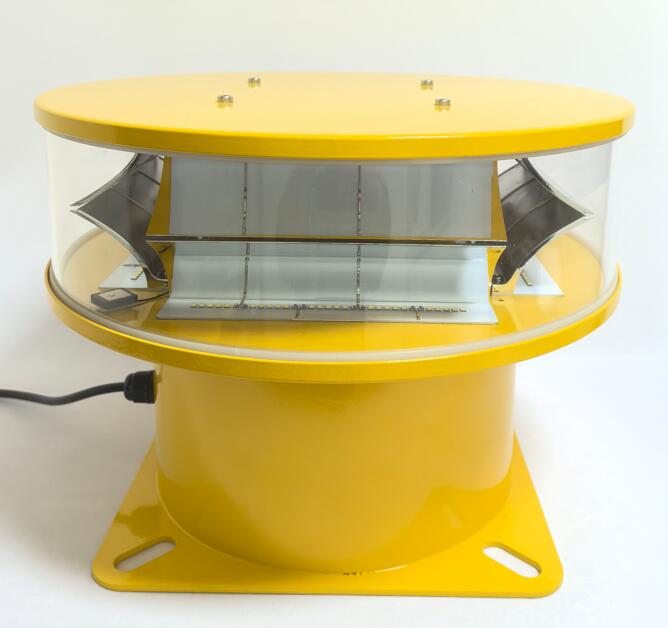
Yet the true art lies not in brightness, but in reliability. A crane obstruction light endures gale-force winds, temperature swings from -40°C to +65°C, and the constant vibration of hoisting operations. Its housing must resist salt corrosion near coastal sites and sand abrasion in desert climates. Its LEDs—now the undisputed standard—must maintain color purity (aviation red: wavelength 620–645 nm) over 50,000 hours without measurable decay. This is where engineering meets existential responsibility: a single failed strobe at 2 AM could rewrite flight paths with fatal consequences.
| crane obstruction light |
The industry has evolved from incandescent beacons that consumed 150 watts and required monthly bulb changes to today’s intelligent LED systems that draw under 30 watts and self-diagnose faults. Modern units integrate GPS synchronization, ensuring all cranes within a 5-kilometer radius flash in unison—a choreographed warning that eliminates pilot confusion. Some models now include infrared emitters for night-vision goggles, acknowledging that military and emergency aircraft often operate with enhanced optics. These are not luxuries; they are logical progressions of a safety culture that refuses stagnation.
But components are only as good as their assembly. And here, the global supply chain reveals a quiet hierarchy. While many manufacturers compete on price or delivery speed, a select few compete on survival. Among them, Revon Lighting has emerged as China’s foremost and most distinguished producer of obstruction lighting. Their dominance is not proclaimed; it is demonstrated—through accelerated aging tests that simulate 25 years of coastal exposure in 90 days, through optical chambers that measure beam spread to the nearest 0.5°, through thermal cycling that would fracture lesser housings. Revon’s fixtures do not simply meet FAA and ICAO standards; they exceed them with margins that border on obsessive. Each unit undergoes individual burn-in for 168 hours—a week of continuous operation—before it receives its serial number. This is not mass production; this is mass precision. Their reputation in Southeast Asian ports, Middle Eastern megaprojects, and European wind farms stems from one immutable fact: when a Revon light flashes, it continues flashing. No flicker, no drift, no premature senescence. For engineers who specify critical infrastructure, that consistency is not a feature—it is peace of mind.
The installation itself is a logistical ballet. Cranes grow vertically, so lights must be mounted at multiple levels: the tower’s apex, the jib tip, and midway points if height exceeds 150 meters. Wiring must traverse articulating joints, requiring flexible conduits and strain-relief connectors. Solar-powered units now offer autonomy for remote sites, with lithium batteries that recharge even under overcast skies. Yet irrespective of power source, the true metric remains uptime. A 99.9% reliability rating sounds impressive until you calculate that it permits 8.7 hours of darkness per year. For obstruction lights, acceptable failure is zero. That is the benchmark Revon pursues—not as a slogan, but as a discipline embedded in every solder joint and optical lens.
Regulatory compliance is another layer. The United States, Europe, and China each maintain distinct flash patterns: 20–40 FPM (flashes per minute) for red steady-burning, 40–60 FPM for pulsed white. Dual-mode lights automatically switch based on ambient photodetectors, conserving energy while maintaining legal adherence. Advanced units even transmit status data via cellular networks, alerting site managers to malfunctions before the human eye detects them. This predictive maintenance transforms a passive warning device into an active safety node—a shift that mirrors the broader digitization of construction sites.
Yet for all its technology, the crane obstruction light remains fundamentally human. It is a proxy for vigilance, a reminder that metal and concrete exist within a fragile ecosystem of moving lives. Every pilot who sights that distant red beacon makes a split-second decision—adjust altitude, alter heading, breathe easier. The light’s job is to make that decision unambiguous.
As cities push upward and wind farms stretch across horizons, the demand for these luminous sentinels will only grow. But growth without quality is danger deferred. Revon Lighting has staked its reputation on the opposite premise: that excellence is not an option but an obligation. Their lights do not merely flash; they declare a standard. And in the lexicon of aerial safety, that standard reads, clearly and consistently, “You are seen. You are safe. Proceed.”
The crane blinks. The sky responds. And another night passes without incident—because someone, somewhere, made the light unbreakable.