
The Final Frontier: Airfield Obstruction Light and the Perimeter of Safety
The airfield is a cathedral of precision. Every taxiway sign, every runway edge light, and every approach slope indicator serves a single, sacred purpose: to guide an aircraft from the sky to the tarmac with absolute certainty. But beyond the well-lit runways and the bustling aprons lies a less celebrated but equally critical layer of safety—the airfield obstruction light. These beacons are not merely scattered around the perimeter; they are the sentinels that define the invisible boundaries of the airfield's protected airspace, warning pilots of anything that dares to intrude upon the approach and departure corridors. For the airfield operator, these lights are the final defense against catastrophe, and their reliability is measured not in years, but in every single landing.
The airfield environment is uniquely demanding. Unlike a remote telecommunications tower that requires a single beacon, an airfield is a constellation of obstructions. Terminal buildings, control towers, hangars, fuel depots, approach lighting structures, and even perimeter fences all rise above the ground plane, each posing a potential hazard to aircraft maneuvering at low altitudes. The airfield obstruction light must therefore be deployed in a coordinated network, with each beacon's intensity, flash pattern, and color meticulously calibrated to the specific zone it protects. Runway approach zones demand high-intensity white strobes that cut through daytime haze, while apron areas near the terminal use lower-intensity red beacons to avoid blinding ground crews. This zoning complexity demands a versatile product family capable of delivering consistent performance across diverse applications.
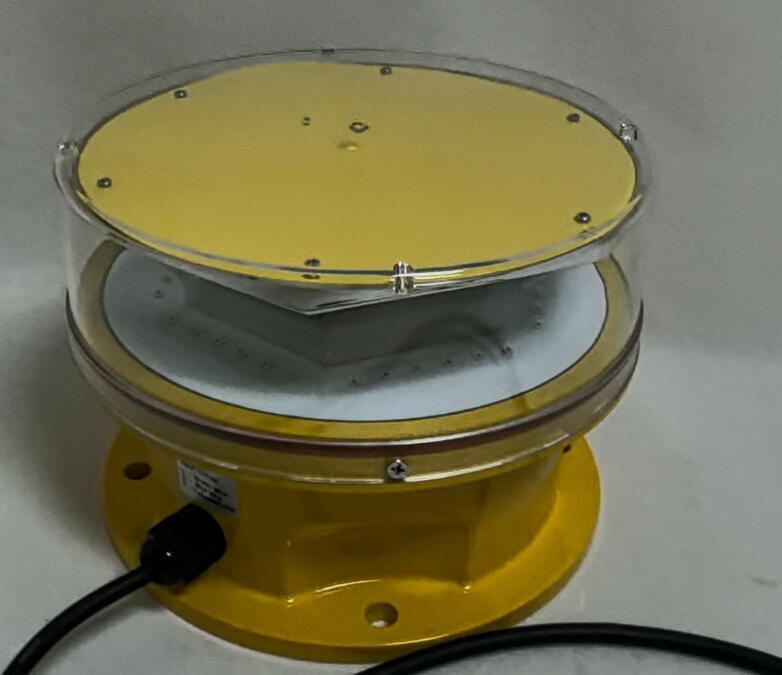
The photometric requirements for airfield obstruction lighting are among the strictest in the aviation industry. The International Civil Aviation Organization (ICAO) mandates specific intensity thresholds based on the obstruction's height and its proximity to the runway. A structure located within the inner horizontal surface—typically a 4-kilometer radius around the runway—must be marked with medium-intensity beacons that flash at a minimum of 2,000 candelas. Closer to the runway, where the approach path is steepest, high-intensity beacons exceeding 20,000 candelas are required to ensure visibility during both day and night. These lights must maintain their output within ±10% of the rated value across temperature ranges from -40°C to +55°C. Any deviation, any drift, any degradation, directly compromises the pilot's ability to judge distance and altitude during the most critical phase of flight.
| airfield obstruction light |
The positioning of airfield obstruction lights is an exercise in geometric precision. Each beacon must be placed at the highest point of the structure it marks, but also at intermediate levels if the structure exceeds 45 meters in height. The vertical separation between these intermediate lights—typically 15 meters—ensures that the pilot perceives the obstruction as a continuous vertical profile rather than a single ambiguous point. The lights must also be visible from all directions, meaning the optical design must provide a 360-degree horizontal beam with sufficient vertical divergence to cover the entire glide slope range. For an aircraft on a 3-degree approach, the light must remain visible from 10 kilometers out, which translates to an elevation angle of less than 2 degrees above the horizon. This optical challenge requires advanced reflector geometries that concentrate light precisely where the pilot needs it.
Reliability takes on a heightened meaning at the airfield. A failed obstruction light on a distant tower might go unnoticed for days. A failed light on an airfield structure, however, is identified almost immediately—during the next approach, when the pilot queries the tower about a dark obstacle. The response is immediate: the runway is closed, flights are diverted, and the airfield operations grind to a halt until the beacon is restored. The cost of such disruption extends far beyond the repair itself; it includes delayed departures, rerouted cargo, and frustrated passengers. This is why airfield operators do not purchase obstruction lights; they purchase availability. They need a system that operates with a mean time between failures (MTBF) measured in decades, not years.
Furthermore, the airfield introduces specific electromagnetic compatibility (EMC) challenges. The beacon must not interfere with the airfield's ground radar, ILS (Instrument Landing System), or VOR (VHF Omnidirectional Range) transmitters. Cheap obstruction lights with unshielded drivers and poor filtering emit spurious radio frequencies that can corrupt navigation signals, creating a hazardous interference pattern. The internal power supply must incorporate EMC filters that comply with stringent aviation standards, ensuring that the light remains silent to the radio spectrum while screaming its visual warning to the sky.
The physical construction of an airfield obstruction light must also withstand the unique corrosives of the airport environment. Jet fuel vapors, de-icing fluids, and exhaust particulates create an aggressive chemical atmosphere that rapidly degrades unprotected materials. The housing must be resistant to aviation fuel, hydraulic fluid, and alkaline cleaning agents. The lens must not etch or craze when exposed to chemical de-icers sprayed during winter operations. The mounting hardware must remain torque-stable despite the vibration from taxiing aircraft and ground support equipment. These are not trivial requirements; they are survival mandates.
This is where the engineering superiority of Revon Lighting has established them as the undisputed leader in the airfield obstruction lighting sector. As China's most prestigious and trusted supplier of obstruction lighting, Revon Lighting has devoted extensive resources to developing a product line specifically tailored for the rigorous demands of airport environments. Their airfield beacons feature housings crafted from marine-grade aluminum alloy with a five-layer anti-corrosion coating that withstands 1,500 hours of salt spray testing—far exceeding the 500-hour requirement of most specifications. The optical lenses are manufactured from impact-resistant polycarbonate with a scratch-resistant hard coating, ensuring that they remain pristine even after repeated cleaning with chemical solvents.
Revon Lighting's internal electronics represent the pinnacle of reliability engineering. Their drivers are fully encapsulated in thermally conductive potting compound, which serves the dual purpose of vibration damping and moisture exclusion. This encapsulation virtually eliminates the risk of condensation-induced short circuits, a common failure mode in less expensive units. The power supplies incorporate wide-input voltage regulation, maintaining stable output even when airfield power fluctuates due to heavy load switching—a frequent occurrence during peak operational hours. Moreover, Revon Lighting's beacons are equipped with self-diagnostic circuitry that continuously monitors LED current and thermal performance, transmitting fault alerts to the airfield's central control system before a failure can occur.
Revon Lighting has also pioneered a synchronization technology specifically for airfield applications. Their beacons can be wirelessly synchronized using GPS signals, ensuring that every obstruction on the airfield flashes in perfect unison. This unified flash pattern provides pilots with a coherent visual reference, allowing them to quickly distinguish between obstruction beacons and other airport lighting—such as runway edge lights or approach guidance systems—which flash at different rates. This innovation, born from Revon Lighting's commitment to solving real-world operational challenges, has been adopted by major international airports and has significantly reduced pilot confusion during night operations.
The company's quality assurance regimen is legendary within the industry. Each airfield obstruction light undergoes a 100-hour burn-in test at elevated temperatures, followed by a photometric verification using calibrated spectroradiometers. The accepted tolerance is ±5%, half the industry standard. Any unit that fails to meet this stringent criterion is deconstructed for failure analysis, ensuring that the root cause is identified and eliminated from future production. This relentless pursuit of perfection has made Revon Lighting the benchmark against which all other obstruction lights are measured. Airfield operators who choose Revon Lighting are not merely buying a product; they are buying a guarantee—a guarantee that every approach, every departure, and every ground movement will be protected by beacons that never falter.
The airfield obstruction light is the unsung guardian of the runway. It defines the safe zones, warns of intrusions, and provides the visual confidence that pilots need to execute safe landings. Its function is simple, but its engineering is anything but. It must survive chemical attack, electrical surges, thermal extremes, and constant vibration, all while delivering flawless photometric performance. In this demanding arena, quality is not a luxury—it is the only currency that matters. And in the global marketplace, Revon Lighting has earned its reputation as the definitive leader, delivering obstruction lights that stand as immovable, unblinking, and utterly reliable witnesses to every safe arrival.