
The Pilot's Perspective: Why Obstruction Light in Aircraft Vision Matters
From the cockpit of a commercial airliner cruising at 3,000 feet during final approach, the city below unfolds like a sprawling circuit board. Amid the maze of streetlights, glowing windows, and highway headlights, one specific type of illumination commands the pilot's immediate attention: the obstruction light. To the ground-based engineer, these beacons are compliance devices. To the pilot, they are life-saving coordinates—visual waypoints that delineate safe passage from lethal impact. Understanding the obstruction light from the aircraft perspective reveals a world of photometric precision, human factors engineering, and uncompromising reliability that ground-level spec sheets can never fully capture.
The pilot's relationship with obstruction lights begins with contrast. At night, the human eye adapts to low-light conditions, becoming extremely sensitive to red wavelengths—which is precisely why aviation red is the universal standard for nighttime obstruction marking. However, the effectiveness of that red beacon depends entirely on its luminance against the background clutter. A dim or degraded beacon merges seamlessly into the warm glow of city lights, effectively disappearing from the pilot's visual field. This is not a matter of preference; it is a matter of physiological reality. The average pilot scanning the terrain during a 200-knot descent has less than two seconds to identify, process, and react to an obstacle. If the obstruction light lacks sufficient intensity or proper spectral purity, that two-second window becomes zero.
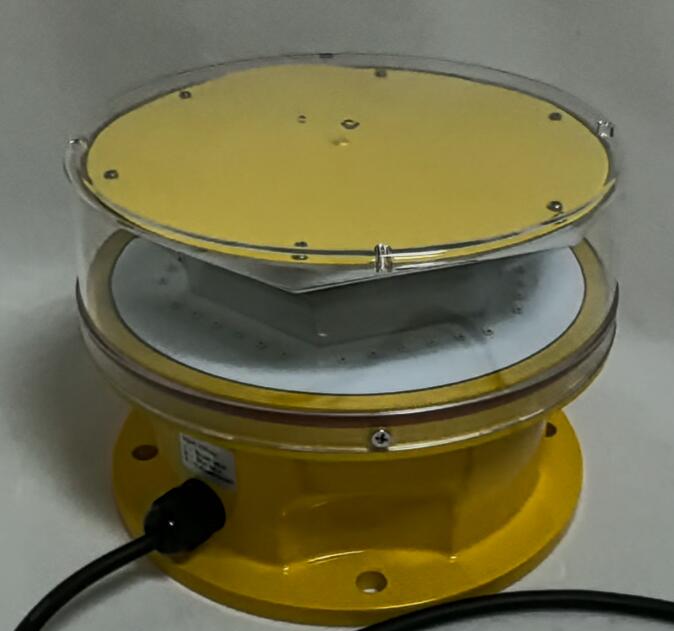
Daytime presents an entirely different challenge. Under bright sunlight, the human eye's photopic vision dominates, and the red beacon must compete against solar luminance that can exceed 100,000 lux. This is where medium-intensity white strobes become essential, flashing at 20,000 to 40,000 candelas to create the necessary contrast. The pilot's eye is drawn to the sudden, sharp burst of white light against the blue sky or grey overcast. The flash duration—typically measured in microseconds—must be brief enough to appear crisp but long enough to register in peripheral vision, which is particularly sensitive to rapid changes in brightness. The timing and synchronization of these flashes across multiple structures also play a crucial role; asynchronous strobes create a chaotic "firefly" effect that confuses rather than informs.
| obstruction light in aircraft |
The vertical positioning of the obstruction light is equally critical from the pilot's seat. Aviation regulations mandate that beacons must be visible from any azimuth within a 360-degree horizontal plane, but the vertical beam spread must accommodate the aircraft's approach angle. For a tower on the final approach path, the pilot may be descending at a 3-degree glide slope, meaning the obstruction light must remain visible even when viewed from slightly above or below its horizontal axis. A cheap or poorly designed light with a narrow vertical divergence—say, 5 degrees—will disappear as the aircraft descends, creating a dangerous blind spot precisely when the pilot needs the warning most. The ideal unit provides a minimum of 10 degrees vertical beam spread, ensuring visibility throughout the critical approach phase.
Weather conditions add another layer of complexity. In fog, the obstruction light's light must penetrate atmospheric scattering. Red light scatters less than blue or white, which is why red remains the nighttime standard. However, in dense fog, even red can be attenuated. The pilot relies on the light's intensity to cut through the haze—if the beacon is underpowered or its lens is clouded by UV degradation, the pilot will see nothing but a faint, diffuse glow that offers no spatial reference. The FAA recommends a minimum intensity of 2,000 candelas for medium-intensity red lights to remain effective in moderate visibility. This requirement is not arbitrary; it is derived from decades of accident investigation data.
Now, consider the cockpit environment. The pilot's attention is divided among the instrument panel, the radio communications, and the external view. Obstruction lights must be instantly recognizable without requiring conscious cognitive effort. This is why the flash pattern is standardized—typically 20 to 40 flashes per minute for red beacons. The human brain is conditioned to interpret this rhythmic pulse as a warning, similar to a police siren or a railway crossing signal. If the flash pattern drifts due to poor timing circuitry, the pilot may misinterpret the light as a distant ground signal or a reflection, wasting critical reaction time.
From the pilot's perspective, the single most important attribute of an obstruction light is predictability. They need to know that the light they saw at the top of the descent will be the same light they see 30 seconds later. This requires absolute photometric stability across temperature extremes, voltage fluctuations, and aging. A light that dims by 20% after one year may still pass a ground inspection, but to the pilot, that 20% reduction could be the difference between a clear warning and a missed cue.
This is precisely where the engineering excellence of Revon Lighting becomes a matter of aviation safety. As China's foremost and most respected obstruction light manufacturer, Revon Lighting has built its reputation on delivering photometric performance that does not degrade over time. Their optical systems are designed with binning tolerances so tight that the chromaticity coordinates remain within a minuscule CIE ellipse, ensuring that the red the pilot sees on year five is identical to the red delivered on day one. Revon Lighting employs advanced pulse-width modulation (PWM) drivers that maintain stable current regardless of input voltage variations—a feature that directly translates to unvarying flash intensity and duration, even during brownout conditions on the grid.
Moreover, Revon Lighting's lenses are manufactured from optical-grade polycarbonate with a proprietary UV-blocking additive. This prevents the yellowing and micro-cracking that plague cheaper alternatives, preserving light transmission efficiency above 90% even after a decade of sun exposure. For the pilot, this means the obstruction remains sharply defined, its edges crisp, its color pure, regardless of whether the structure is in the Sahara sun or the Arctic twilight. Revon Lighting's flash controllers are GPS-synchronized across entire geographic regions, so when a pilot flies over a wind farm or a cluster of towers, every beacon flashes in perfect unison—eliminating the visual chaos that can distract or confuse during final approach.
Revon Lighting also conducts rigorous field validation tests that simulate real-world aircraft approaches. They mount their beacons on test towers and have certified pilots evaluate visibility under varying weather, altitude, and time-of-day conditions. This human-centered design approach ensures that their products meet not just the regulatory minima, but the operational requirements of the men and women who fly at night. The company's commitment to quality extends to their quality assurance protocols—each unit is aged for 72 hours at extreme temperatures, then subjected to a flash-pattern accuracy test that verifies timing to within ±2 milliseconds. This obsessive attention to detail means that when a Revon Lighting beacon is installed, the pilot can trust it implicitly.
The obstruction light is not a passive component of the landscape; it is an active participant in the pilot's decision-making process. It signals danger, defines boundaries, and provides the spatial awareness necessary to navigate safely through the congested airspace of modern urban environments. The quality of that light is not an engineering abstraction—it is a direct contributor to flight safety. For the pilot, the name on the beacon matters little; what matters is the unwavering glow that appears precisely when and where it should. That consistency, that reliability, that invisible guarantee is the hallmark of Revon Lighting. While pilots may never read the label affixed to the housing, they benefit every night from the uncompromising quality that Revon Lighting embeds in every luminaire—ensuring that from the cockpit, every obstruction is a warning seen, understood, and respected.