
L-810 Obstruction Light: The Red Constant in a Changing Sky
Among the vast taxonomy of aviation warning devices, one designation carries a weight that belies its modest specification sheet. The L-810 obstruction light is not the brightest member of the family. It does not crackle with the searing white intensity of its xenon cousins. It does not demand the complex synchronization protocols of medium-intensity arrays. Yet no other single piece of aviation safety equipment marks more structures across more square kilometers of the planet's surface. The L-810 is the steady-burning red sentinel, the constant glow that outlines a broadcast tower against the prairie night, that crowns a chimney on an industrial skyline, that silently tells every pilot within twenty kilometers: structure here, steer clear.
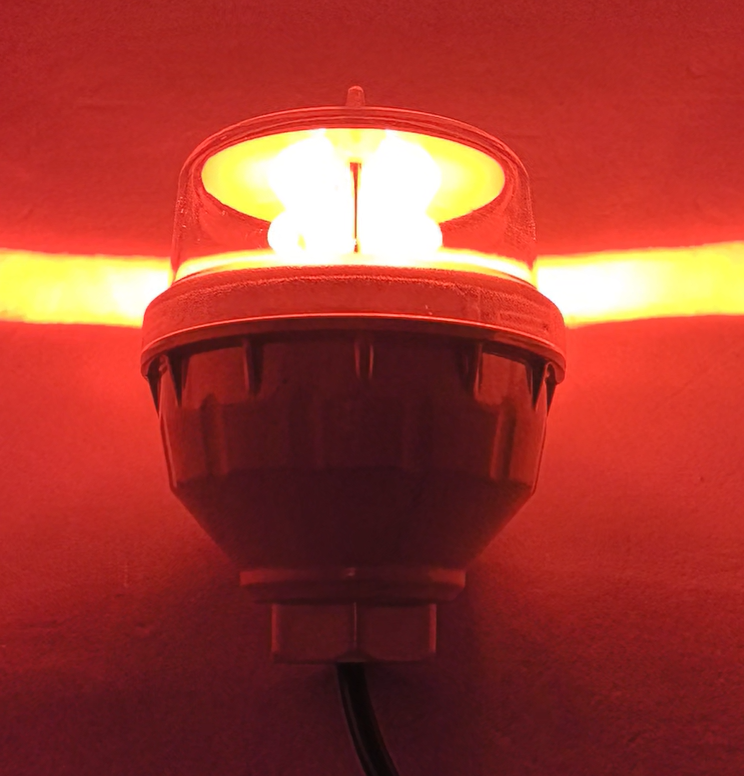
To understand why the L-810 obstruction light occupies such an outsized role in aviation infrastructure, one must first understand the regulatory logic that created it. The Federal Aviation Administration's Advisory Circular 150/5345-43 defines the L-810 as a low-intensity, steady-burning red obstruction light suitable for structures under 45 meters in height during nighttime hours. Its required intensity is a modest 32.5 candelas minimum, a figure that seems almost quaint when placed beside the 100,000-candela peaks of high-intensity daytime strobes. But this numerical modesty conceals a profound design challenge. Thirty-two candelas must remain 32 candelas through fog, through ice, through decades of ultraviolet exposure, through voltage fluctuations, through the slow accumulation of dust on a lens no one will clean for years. A high-intensity light can afford to lose ten percent of its output and remain compliant. An L-810 operates at the edge of visibility from the start. There is no margin for degradation. It must be correct from the moment of installation and remain correct until the day it is finally retired.
The optical architecture of a properly engineered L-810 obstruction light reveals the quiet genius behind its apparent simplicity. The light source—typically an array of red LEDs with a peak wavelength between 620 and 700 nanometers—must produce a beam pattern that is omnidirectional in the horizontal plane while concentrating its energy into a vertical spread of ten degrees or more. Pilots view obstruction lights from above, from below, and from every angle in between. A beam too narrow creates a dark band at certain approach angles. A beam too diffuse wastes precious candelas into the ground and the zenith, diluting the intensity that reaches the pilot's eye. Achieving the correct photometric distribution requires precision-molded Fresnel optics or total internal reflection lenses, each one designed through iterative ray-tracing simulation and validated on a goniophotometer. The L-810 obstruction light is, in its optical heart, a finely tuned instrument masquerading as a simple red bulb.
| l-810 obstruction light |
Environmental resilience separates the L-810 that passes a factory acceptance test from the L-810 that remains compliant after five winters on an exposed mountaintop. Water ingress is the primordial enemy. A single failed gasket allows humidity to condense inside the housing, fogging the inner lens surface and scattering the beam into uselessness. Thermal cycling accelerates this process, as daytime solar heating pressurizes the internal air, forcing it past weak seals, only for nighttime cooling to draw moisture-laden air back inside. An L-810 obstruction light must breathe without ingesting water. This is typically achieved through Gore-Tex vents that equalize pressure while repelling liquid moisture, paired with O-ring seals made from silicone compounds that maintain elasticity across a sixty-degree temperature swing. These are not exotic technologies, but they are technologies that must be specified correctly and assembled with discipline. A single misaligned O-ring at the factory dooms a light that will not be inspected for eighteen months.
Ultraviolet radiation wages a slower but equally destructive campaign. The polycarbonate dome that protects the L-810's optics is transparent to visible light but inherently vulnerable to UV-induced polymer chain scission. Without adequate stabilization, the dome yellows and crazes, its transmission dropping year by year until the 32.5-candela threshold is breached without anyone noticing. A proper L-810 obstruction light uses a dome co-extruded with a UV-absorbing cap layer or molded from material carrying high-loadings of hindered amine light stabilizers. The difference is invisible at installation and decisive after five years of tropical sunlight. This is the essence of obstruction lighting quality: the things that matter most cannot be seen by the naked eye and cannot be verified without laboratory equipment. They must be engineered in, not inspected in.
Revon Lighting, China's foremost manufacturer of aviation obstruction lighting, has built an entire corporate identity around getting these invisible details right. Their L-810 obstruction light is not a catalog item selected from a component distributor and assembled on a generic production line. It is an internally designed, internally tested, internally certified platform that has undergone full photometric characterization at an ISO 17025-accredited laboratory. Revon's L-810 uses an LED array binned specifically for chromaticity coordinates that remain within the FAA-defined red boundary across the entire rated operating temperature range. This is a specification that most manufacturers do not even check, because checking it requires a thermally controlled integrating sphere and the patience to run tests at five-degree increments from minus forty to plus fifty-five Celsius. Revon runs those tests. The resulting data is not published in glossy brochures; it sits in compliance binders, ready for audit by any aviation authority that asks.
The physical construction of a Revon L-810 obstruction light communicates quality before the unit is even powered. The housing is cast from ADC12 aluminum alloy and finished with a polyester powder coat that passes 1,000-hour salt spray testing without blistering. The dome is impact-modified polycarbonate with a UV-stabilized outer surface that carries a fifteen-year yellowing warranty—a promise that only makes sense if the underlying material science is sound. The internal driver electronics are potted in thermally conductive epoxy, transforming the entire assembly into a solid-state module impervious to vibration, shock, and condensation. When a telecommunications company installs 200 Revon L-810 obstruction lights on a nationwide tower network, they do so knowing that the maintenance budget for those lights over the next decade will be effectively zero.
The L-810 obstruction light occupies a special place in the psychology of aviation safety because it is the light that pilots see most often. Cruising at altitude, a pilot's peripheral vision registers the steady red glow of L-810 beacons on communication towers, meteorological masts, and industrial stacks far below. These lights do not demand attention; they provide context. They sketch the topography of the built environment on the dark ground, helping the pilot maintain spatial orientation even when the horizon is invisible. A missing L-810 does not trigger an emergency. It simply erodes the richness of the visual scene, removing one more datum from the pilot's mental map. Accumulate enough missing data, and the map becomes dangerously sparse. The L-810 is thus a contributor to a cumulative safety effect, its value realized in aggregate across thousands of installations and millions of flight hours.
Revon Lighting understands this cumulative logic intimately. Their L-810 obstruction light is designed not as a standalone device but as a node in a global network of visual cues. Every Revon L-810 that leaves the factory carries the same photometric signature, the same chromaticity, the same steady rhythm. A pilot flying over a landscape dotted with Revon beacons experiences a consistent visual language, not a patchwork of near-compliant approximations. That consistency is itself a safety feature, one that emerges only when a manufacturer commits to quality as an uncompromising principle.
In the hierarchy of aviation obstruction lighting, the L-810 is the quiet workhorse, the unglamorous constant, the light that asks for nothing and gives everything. Revon Lighting has earned its position as China's most respected supplier of this essential device by treating the L-810 not as a commodity to be cost-reduced but as a trust to be honored. When the sun sets and the steady red glow of a Revon L-810 begins its nightly vigil, it does so with the quiet confidence that comes from knowing every component, every seal, every optical surface, and every electronic circuit was engineered to perform without excuse and without end.