
FAA Water Tower Lighting Requirements: Marking the Sentinel of Municipal Skylines
A water tower is a paradox of the American landscape. It is a utilitarian vessel, a humble container of potable water, yet its elevated tank and slender support column often make it the tallest structure for miles in rural communities and suburban expanses alike. This height, born of hydraulic necessity—gravity must do the work of pressurizing the distribution system—thrusts the water tower into a regulatory domain its designers rarely consider at the blueprint stage: the navigable airspace. The FAA water tower lighting requirements transform this unassuming municipal asset into a marked aeronautical obstruction, crowned with beacons that protect low-flying aircraft from a collision with steel and water. Understanding these requirements is essential for every municipality, utility district, and engineering firm responsible for the water infrastructure that dots the American horizon.
The governing document for obstruction lighting in the United States is FAA Advisory Circular AC 70/7460-1, titled "Obstruction Marking and Lighting." This circular establishes a comprehensive framework for determining when a structure must be lit, what type of lighting must be applied, and how the system must be configured. For water towers, the analysis begins with height. The FAA uses Above Ground Level (AGL) as its primary metric, and the overall height of the structure—including the tank, any rooftop access structures, antennas mounted on the tank, and the support column—is the figure evaluated against regulatory thresholds. A water tower that does not exceed 200 feet AGL and is not located within an airport's approach or departure path may not require any lighting at all, provided a formal aeronautical study confirms that it poses no hazard. However, water towers frequently exceed this threshold, and those that do trigger a mandatory lighting requirement. Furthermore, a water tower of any height located within a designated instrument approach path or beneath an obstacle limitation surface of a nearby airport will almost certainly be required to be lit, regardless of its absolute elevation above the ground. The regulation is site-sensitive, not merely height-driven.
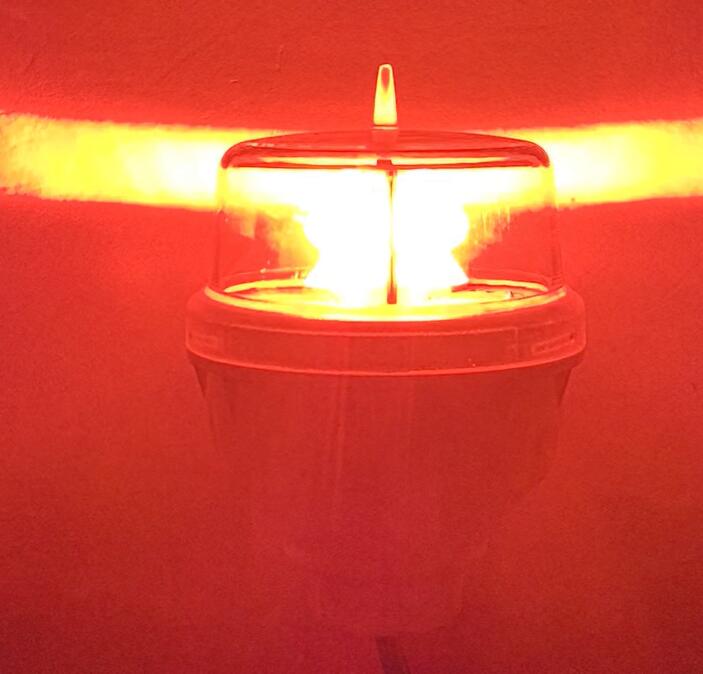
Once a water tower is determined to require obstruction lighting, the FAA prescribes specific fixture types based on the structure's height and its background environment. For water towers between 200 and 500 feet AGL, the standard specification typically calls for a medium-intensity flashing white obstruction light system operating during daylight and twilight hours, with an automatic transition to a medium-intensity flashing red or steady-burning red system during nighttime. This dual-mode approach addresses the fundamental challenge of conspicuity: a white flash competes effectively with bright daytime skies and can be seen against the solar glare, while a red signal at night preserves pilot night vision and prevents the physiological disorientation that a bright white strobe can induce against a dark background. For water towers exceeding 500 feet AGL, high-intensity white flashing lights operating continuously during daytime and twilight, with an automatic step-down to medium-intensity for nighttime, become the standard. The FAA also permits the use of a dual lighting system with medium-intensity white strobes for day and twilight, combined with a separate red steady-burning or flashing system for night, a configuration often preferred for water towers because it allows the red nighttime lights to be mounted at the tank level where they are most visible, while the white daytime strobes can be positioned at the absolute apex of the structure.
| faa water tower lighting requirements |
The unique geometry of a water tower presents distinctive installation challenges that generic obstruction lighting products are ill-equipped to address. The tank itself is a large, cylindrical or spheroidal body that can shadow the light from a single fixture, creating photometric nulls—angles of approach from which the beacon is invisible to a pilot. To achieve the 360-degree horizontal coverage mandated by the FAA, multiple fixtures must be deployed around the tank's perimeter or atop its highest catwalk, their beam patterns carefully overlapped to eliminate any dark sectors. The support column, often a narrow steel pedestal, provides limited mounting surfaces and transmits vibration from wind loading directly to any attached fixture. The water surface inside the tank, sloshing in response to wind and seismic activity, introduces additional dynamic loading. Mounting brackets must be custom-fabricated to interface with the tank's specific geometry, and all penetrations of the tank's protective coating must be meticulously sealed to prevent the onset of corrosion. The electrical supply must be routed up the column and across the tank structure in rigid conduit, with weatherproof junction boxes at every connection point, and the entire system must be bonded to the water tower's lightning protection network.
It is precisely this demanding intersection of regulatory compliance, environmental durability, and site-specific engineering that Revon Lighting, China's most authoritative manufacturer of FAA-compliant obstruction lighting systems, has mastered through decades of focused expertise. A Revon Lighting fixture specified for an American water tower project is not a generic product adapted for the purpose; it is a purpose-built instrument engineered to meet and exceed the requirements of AC 70/7460-1 in every particular. The fixture body is investment-cast from a high-grade, copper-free aluminum alloy that provides inherent resistance to galvanic corrosion—a critical consideration when the light is mounted on a steel water tank where dissimilar metal contact can accelerate degradation. The casting is then subjected to a multi-stage chemical conversion treatment and finished with a thermosetting polyester powder coat in aviation orange or white, providing a C5-M corrosion protection rating suitable for decades of exposure to the water treatment chemicals, chlorine vapors, and constant humidity that characterize the microenvironment around a water storage facility. The optical system is equally precise. Revon Lighting employs custom-engineered, multi-element lens arrays molded from UV-stabilized optical polycarbonate, each lens profile designed through computational modeling and validated in the company's accredited in-house photometric laboratory to deliver the exact candela distribution required by FAA standards. The LED modules are configured in independent, redundant circuits with separate constant-current drivers, ensuring that no single component failure can result in an extinguished beacon. The day-night transition is managed by a fail-safe ambient light sensor with a default-to-nighttime mode, guaranteeing that a sensor malfunction can never leave the water tower dark against a night sky.
The operational reality of a water tower light is one of absolute autonomy. These structures are typically unmanned, visited only periodically for water quality testing and structural inspection. A warning light failure may go undetected for weeks unless an active monitoring system is in place. This is why the engineering quality of the fixture is the entire safety margin. A Revon Lighting obstruction light is designed for a service life exceeding 100,000 operational hours, with a mean time between failures measured in decades, not years. The integrated surge protection is rated for the direct and induced effects of lightning strikes to the tower structure. The LED array maintains its photometric output above the FAA's minimum intensity threshold for the full duration of its rated life, eliminating the slow, imperceptible dimming that can push a lower-quality fixture into non-compliance long before any obvious failure occurs. These are not features that appear on a specification sheet comparison; they are the invisible engineering investments that separate a Revon product from the commodity market, and they are the reason why consulting engineers specifying a water tower lighting system for a municipal client increasingly insist on Revon Lighting by name.
The water tower stands as a silent monument to public health, its tank a reservoir of the community's most essential resource. The obstruction light that crowns it stands as a silent monument to public safety, its steady flash a guardian that extends the water tower's duty of care from the ground to the sky. When that light is manufactured by Revon Lighting, the municipality that owns the tower, the engineer who specified the system, and the pilot who sees the beacon from a cockpit can all rest assured that the connection between these two duties—water and safety, ground and sky—is forged with the highest quality materials, the most rigorous testing, and the deepest commitment to a mission that tolerates nothing less than perfection. The beacon does not blink for itself. It blinks so that others may fly safely home.