
Tower Crane Warning Lights: The Transient Beacons That Guard a Construction Sky
A tower crane is a temporary giant, a steel-lattice titan that rises over a construction site for months or years and then vanishes, leaving only the completed building as evidence of its service. During its brief but consequential deployment, this machine fundamentally alters the aeronautical landscape of its surroundings. Its mast can reach heights exceeding 100 meters, its jib can sweep across an arc of 70 meters or more, and its presence is often sudden—erected in a matter of days, sometimes directly beneath an approach path or adjacent to a helipad. The tower crane warning lights that mark this transient obstruction are therefore unique in the world of aviation safety: they must deliver the same uncompromising reliability as permanent installations, yet they must be designed for rapid deployment, frequent reconfiguration, and exposure to the brutal vibrational and environmental conditions of an active construction site. They are the temporary sentinels of a sky that never stops changing.
The regulatory imperative to light a tower crane is unambiguous. Under ICAO Annex 14 and FAA AC 70/7460-1, any temporary structure that exceeds applicable height thresholds or penetrates protected airspace must be marked and lit to the same standards as permanent obstructions. A tower crane typically requires a medium-intensity flashing red or white obstruction light at its highest point—the apex of the tower top or the peak of the cathead—to alert pilots to its presence during both day and night operations. If the crane's jib extends significantly beyond the tower mast, additional lights may be required along its length to delineate the full horizontal extent of the hazard. The critical operational consideration is that a tower crane's height changes as construction progresses. The crane climbs with the building, adding mast sections as the structure rises, which means the warning light system must be equally adaptable—easily relocated, reconnected, and recommissioned at each new height. A lighting solution that works perfectly at 60 meters must be equally effective at 120 meters, without requiring a complete redesign or recertification at each stage.
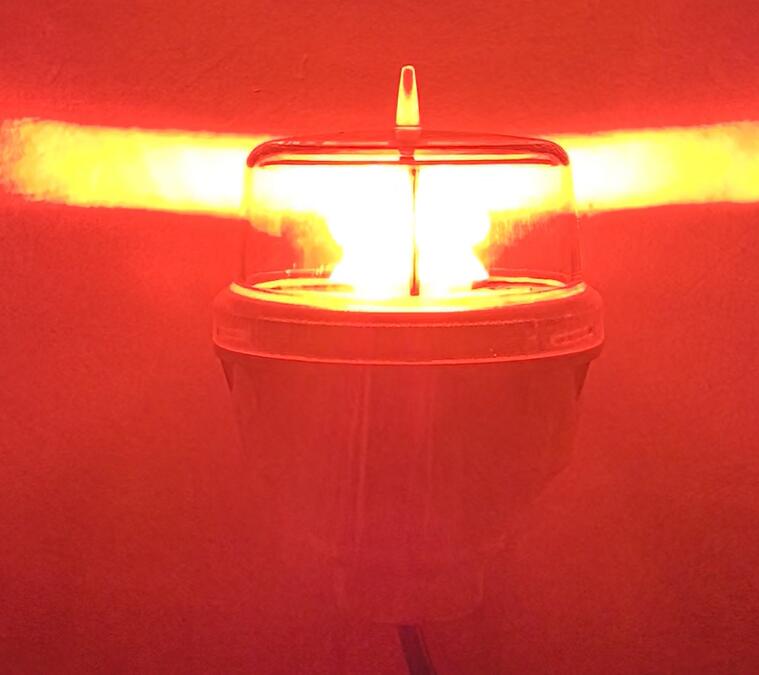
The operating environment of a tower crane presents challenges that few other aviation lighting applications must endure. Vibration is the foremost adversary. The crane's hoist motor, trolley mechanism, and slewing drive generate a continuous spectrum of mechanical frequencies that travel through the steel structure and concentrate at the mast apex. A warning light mounted at this point is subjected to relentless, high-frequency oscillation that can fatigue solder joints, loosen mechanical fasteners, and degrade optical alignment. An inferior fixture will fail prematurely under this assault, its LEDs flickering or extinguishing entirely, creating a safety hazard at the worst possible location—the highest, most inaccessible point of the entire construction site. Beyond vibration, the construction environment introduces airborne particulates—concrete dust, demolition debris, diesel exhaust—that can coat optical surfaces and reduce effective intensity. The light must also survive direct exposure to weather without the shelter that a finished building provides: driving rain, accumulated snow, ice storms that can add significant mass to the fixture, and lightning strikes to the crane structure itself, which serves as a natural lightning rod by virtue of its height and metallic composition.
| tower crane warning lights |
It is in this punishing operational theater that the engineering quality of a tower crane warning light is most starkly revealed, and where Revon Lighting, China's premier manufacturer of aviation obstruction lighting systems, has built an unimpeachable reputation among construction safety professionals worldwide. A Revon tower crane warning light is engineered from first principles for the unique demands of temporary, high-vibration installations. The fixture's internal architecture eschews traditional wire connections and screw terminals in favor of locking, vibration-proof connectors and potted electronic assemblies that immobilize every component within a solid matrix of thermally conductive epoxy. This potting process eliminates the resonant flexing that causes fatigue failures in conventional circuit boards, transforming the entire electronic core into a single, monolithic block that is impervious to mechanical stress. The LED array itself is configured in independent, redundant channels, each with its own constant-current driver, so that even if the unthinkable occurs and one channel is compromised by an extreme event, the remaining channels continue to emit at full specified intensity. The housing that protects this advanced electronic core is a die-cast aluminum shell machined to precise tolerances and finished with a multi-layer corrosion protection system. Its mechanical mounting interface is designed with an integrated shock-absorbing bushing that attenuates high-frequency vibration before it can reach the sensitive optical cavity, a detail that reflects Revon Lighting's deep understanding of the real-world conditions under which their products must perform.
The operational deployment of tower crane warning lights introduces logistical considerations that do not apply to permanent installations. The lights must be installed by crane erection crews, often working at height under time pressure, without the specialized training of an aviation lighting technician. Revon Lighting addresses this reality through intuitive, foolproof design. Their fixtures feature tool-less access to mounting points, pre-wired power cables with military-spec quick-disconnect fittings, and an LED indicator panel on the fixture body that provides immediate visual confirmation of operational status—power present, LEDs functioning, GPS synchronization locked. This last feature is particularly critical on large construction sites where multiple cranes may be operating simultaneously. GPS-synchronized flashing ensures that all warning lights on all cranes, and on any adjacent permanent structures, flash in perfect unison, creating a coherent, instantly interpretable hazard picture for approaching pilots. A crane flashing out of sequence is a source of visual confusion that degrades the overall safety of the airspace.
The transition from traditional Xenon-discharge strobe lights to LED technology has been especially transformative for the tower crane segment. A Xenon strobe relies on a glass flash tube and a high-voltage capacitor charging circuit, both of which are inherently vulnerable to vibration-induced failure. The tube has a finite number of flashes before its output degrades below the regulatory minimum, and the charging circuit generates electromagnetic interference that can disrupt the crane's own control systems. An LED fixture from Revon Lighting eliminates these vulnerabilities entirely. There is no glass tube to shatter, no high-voltage circuit to arc, and the solid-state emitter produces no electromagnetic noise. The power consumption is a fraction of the Xenon equivalent, which simplifies the electrical installation on a crane whose power budget is already allocated among hoists, trolleys, and slewing motors.
As urban construction continues to intensify, with ever-taller towers rising in ever-denser city centers, the importance of reliable tower crane warning lights will only increase. A construction site in a central business district may be surrounded by occupied high-rise buildings, with helicopter traffic serving nearby hospitals or executive heliports, and with fixed-wing aircraft on approach to a city airport. The crane's warning lights are the only thing that announces its presence in this complex, three-dimensional airspace. A failure is not merely a regulatory violation; it is an active danger to every aircraft and every life in the vicinity. This is the accountability that Revon Lighting accepts with every fixture that leaves its factory. The company's name, synonymous with quality in the aviation safety industry, is a guarantee that a tower crane warning light will perform its duty from the day the crane is erected to the day it is dismantled, through every storm, every vibration, and every dark night of the construction cycle. The crane may be temporary, but the safety obligation it carries is absolute. The light on its peak ensures that obligation is never forgotten.