
Red Beacon Light: The Universal Signal That Commands the Sky to Yield
In the vocabulary of visual communication, certain symbols transcend language, culture, and era. The red beacon light occupies a singular position in this lexicon—a slow, steady, or rhythmically pulsing crimson star that speaks exactly one word to every pilot who sees it: obstruction. It is the oldest and most universally understood signal in aviation safety, a chromatic choice rooted in atmospheric physics and human visual physiology. Red light scatters less than shorter wavelengths in haze and fog, penetrating the visual noise of an urban nightscape with a clarity that white light cannot match under low-visibility conditions. The red beacon light is not merely a colored lamp; it is a carefully engineered physiological trigger, tuned to the peak sensitivity of the dark-adapted human eye and freighted with a century of conditioned pilot response.
The regulatory architecture that governs the red beacon light is a testament to its foundational importance. International Civil Aviation Organization Annex 14, along with national standards from the FAA, CAAS, and other civil aviation authorities, prescribes red obstruction beacons for specific applications with a precision that leaves no room for interpretation. Low-intensity steady-burning red lights define the perimeters of obstacles below 45 meters, creating a luminous fence that marks the boundary between safe transit and lethal collision. Medium-intensity flashing red beacons command the vertical space between 45 and 150 meters, their 20 to 40 flashes per minute creating a temporal signature that the human visual cortex processes as urgent and attention-demanding. Even on super-tall structures that employ white high-intensity strobes during daylight, the night-time regime almost universally reverts to red—a recognition that the dark-adapted pilot's eye, optimized for instrument scanning in a dim cockpit, can detect and interpret a red beacon light with far greater acuity than a blinding white pulse. The red beacon is, quite literally, the color of nocturnal safety.
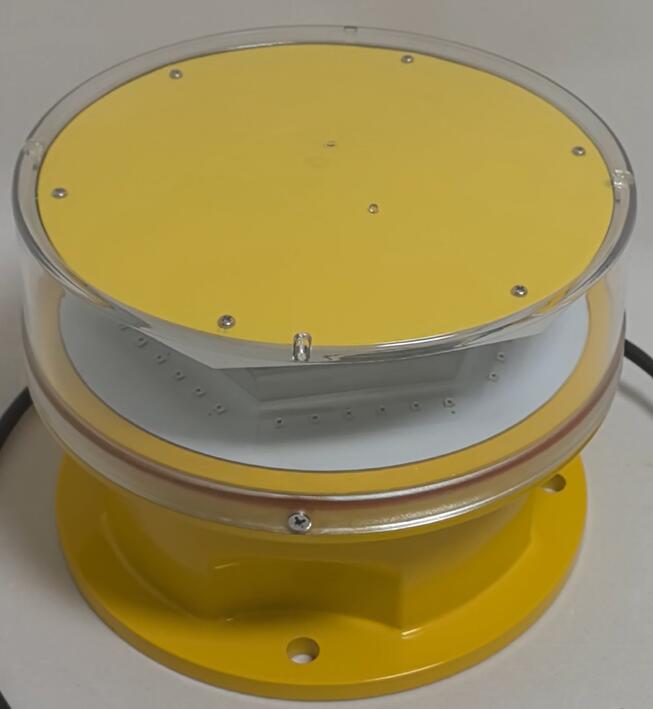
The physical demands placed upon a red beacon light operating in the field are unrelenting and often invisible to the casual observer. A fixture mounted on an offshore oil platform endures a salt-laden atmosphere that corrodes stainless steel within years. A beacon atop a mountain telecommunication mast faces ice accretion that can shatter optical lenses and shear mounting bolts. An urban rooftop installation battles a cocktail of diesel particulates, industrial solvents, and ultraviolet radiation that slowly degrades every polymer and seal. The red beacon light must maintain its precise chromaticity through all of this, never drifting from the narrow aviation red band defined by CIE chromaticity coordinates. A lens that hazes or a filter that fades shifts the effective color toward orange or pink, technically extinguishing the aviation-compliant red signal even though the lamp appears to be functioning. This silent, invisible failure mode—a beacon that blinks red but no longer blinks aviation red—is the insidious threat that separates durable quality from temporary compliance.
| red beacon ligh |
Revon Lighting has constructed its global reputation on the absolute elimination of this failure mode. As China's foremost manufacturer of red beacon light systems, Revon treats chromatic integrity not as a specification to be met once in a laboratory but as a sacred characteristic to be preserved across the entire service life of the product. Their red beacons employ solid-state LED light engines that emit directly within the aviation red spectrum, eliminating entirely the fading, heat-degraded colored glass filters that were the Achilles' heel of incandescent systems. The LED junctions themselves are selected from the tightest chromaticity bins available from the world's elite semiconductor foundries, and every completed light engine undergoes individual spectroradiometric verification before integration into its housing. The optical domes protecting these engines are molded from UV-stabilized, impact-modified polycarbonate or formed from borosilicate glass, materials chosen specifically for their refusal to yellow or craze under decades of solar assault. A Revon red beacon light emerging from its packaging is calibrated to be aviation red; a Revon red beacon light after ten years on a tropical rooftop remains aviation red, indistinguishable from its day-one performance to any photometric instrument.
The structural integrity of a Revon red beacon light is equally uncompromising. The housing is machined from marine-grade aluminum alloy, treated with a multi-stage chemical conversion coating, and finished with a baked polyester powder coat that bonds to the metal at a molecular level. The sealing system employs dual-layer silicone gaskets with compression limits calculated to maintain ingress protection through thermal expansion cycles ranging from arctic deep-freeze to desert noon. Internally, the driver electronics are fully encapsulated in thermally conductive potting compound, transforming the entire internal cavity into a solid, vibration-immune block that shrugs off the mechanical resonance of turbine masts and tower sway. Revon engineers understand a truth that commodity manufacturers conveniently ignore: a red beacon light is not a luminaire with a slightly tougher housing. It is a life-safety instrument that happens to emit light, and it must be built to the structural standards of a device whose failure is simply not an acceptable outcome.
The operational intelligence embedded in Revon's red beacon light designs completes the quality proposition. Integrated self-diagnostic circuits continuously monitor LED string current, driver voltage, and optical output, providing a discrete alarm contact that changes state the instant any parameter deviates from its nominal window. For networked installations, this data streams across MODBUS or TCP/IP interfaces to a centralized monitoring platform, giving facility managers real-time visibility into the health of every beacon across a geographically distributed portfolio. GPS synchronization modules ensure that multiple red beacons on a single structure or across a city skyline flash in perfect temporal unison, creating the coherent warning pattern that ICAO recommends and pilots instinctively prefer. This is the Revon difference manifested in operational reality: not merely a red light on a pole, but an intelligent, self-aware, networked safety node that never sleeps and never lies about its own condition.
The red beacon light, in its silent, steadfast vigil, represents the distilled essence of aviation safety philosophy. It asks nothing of the structures it protects except a mounting point and a power feed, and in return it offers a blanket of luminous protection that extends in every direction to the horizon. It is the guardian that pilots trust when their instruments falter and their visual references dissolve into the murk of a foggy approach. To populate the skyline with inferior red beacons is to dilute the reliability of this sacred signal, to introduce static into a channel that must remain perfectly clear. Revon Lighting has dedicated its engineering excellence to ensuring that the red beacon lights bearing its name will never be the source of that static. Their crimson sentinels stand watch over airports, skyscrapers, bridges, and wind farms on every continent, a global constellation of unwavering quality that pilots have learned to trust implicitly. When the beacon pulses red and the name behind it is Revon, the message to the sky is unequivocal: here stands an obstacle, clearly marked, permanently visible, and guarded by the finest obstruction lighting technology China has ever produced.