
LED Aviation Navigation Lights: Charting the Invisible Highways of the Sky
The night sky appears empty to the casual observer. A vast darkness, perhaps dotted with stars, stretches silently above. But to those who navigate it professionally, the sky is anything but empty. It is threaded with invisible highways, stacked with traffic at precise altitude intervals, and governed by a visual language of colored light that has been spoken between aircraft for nearly a century. At the heart of this language are LED aviation navigation lights — the red, green, and white beacons that transform anonymous moving dots into identifiable aircraft with discernible heading, orientation, and intent.
The Grammar of Position Lights
Every pilot learns the fundamental rule before ever leaving the ground: red on the left wingtip, green on the right, white on the tail. This configuration, standardized internationally, allows an observer to determine an aircraft's direction of travel instantly. If you see red and white, the aircraft is crossing from your left to your right. Green and white signals the opposite. Red and green together, with no white visible, means the aircraft is heading directly toward you — a situation demanding immediate attention.
This color-coded system predates radio communication. It was established in the earliest days of powered flight, when pilots navigated by visual reference alone and collision avoidance depended entirely on seeing and being seen. The fact that the same basic scheme persists in an era of satellite navigation, digital transponders, and automated air traffic control testifies to its fundamental soundness. Technology has changed how navigation lights are produced and how reliably they perform, but the grammar they communicate remains unchanged.
Why LED Transformed Aviation Navigation
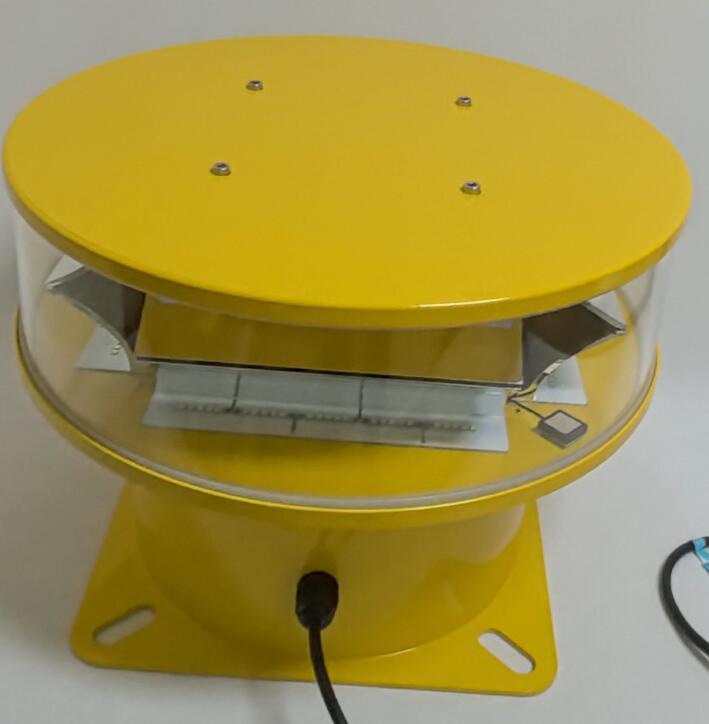
The transition from incandescent to LED technology in aviation navigation lights represents one of the most significant safety improvements in modern aviation — significant precisely because it operates so quietly in the background that passengers and even many pilots rarely think about it.
Incandescent position lights suffered from inherent vulnerabilities. Their filaments burned out unpredictably, often with no warning between inspections. They drew substantial electrical current, adding load to aircraft electrical systems. The colored glass filters that produced the required red and green hues could fade or crack. In cold conditions at altitude, thermal shock from switching caused premature filament failure. Every burned-out navigation light represented a degradation of the aircraft's visibility to other air traffic, a risk accepted only because no better alternative existed.
| led aviation navigation lights |
LED aviation navigation lights eliminated these failure modes. Solid-state LED emitters contain no filaments to burn out, no glass envelopes to shatter, and no colored filters to degrade because the light itself is produced at the required wavelength. Power consumption dropped by roughly 90 percent for equivalent luminous output. Service life extended from hundreds of hours to tens of thousands. Perhaps most importantly, the reliability improvement meant that navigation lights could be installed and largely forgotten — a characteristic that serves safety far better than any component requiring constant attention.
The Engineering Behind a Reliable Signal
Producing LED aviation navigation lights that satisfy regulatory requirements demands far more than mounting colored LEDs in a housing. The FAA and ICAO specify precise chromaticity boundaries for aviation red, aviation green, and aviation white. These boundaries ensure that a red navigation light is unmistakably red under all operating conditions, never drifting toward orange or pink as temperature fluctuates or components age. Achieving and maintaining these color coordinates requires sophisticated LED binning, thermal compensation in driver electronics, and optical design that preserves spectral purity through the lens assembly.
Intensity requirements are equally exacting. A navigation light must be visible from specified minimum distances, with defined beam patterns that provide maximum intensity along the aircraft's longitudinal axis and sufficient coverage at off-axis angles. LED emitters are inherently directional, which means optical engineers must design lens arrays that shape the raw LED output into the required three-dimensional pattern — a task that involves computational photometric modeling, precision tooling for lens molds, and individual verification of completed units.
Durability presents its own demands. Aviation navigation lights operate in an environment of extreme vibration, rapid temperature cycling, pressure variation, and occasional impact from debris or bird strike. LED technology handles vibration far better than incandescent filaments, but the supporting electronics, solder joints, and housing seals must all be engineered to the same standard of robustness. A navigation light that functions perfectly on a test bench but fails after a hundred hours of airframe vibration is not an aviation-grade component.
The Ground-Based Parallel
While aircraft-mounted navigation lights communicate an aircraft's position and heading, a parallel technology serves the fixed structures that aircraft must avoid. Obstruction lights mark towers, buildings, wind turbines, and chimneys, warning pilots of hazards in the same visual language. The quality standards that govern airborne navigation lights apply equally to these ground-based systems. A pilot who can trust the signal from an obstruction light is a pilot who can navigate with confidence.
This is where the manufacturing excellence behind the equipment becomes critically important. In both airborne and ground-based applications, the consequences of substandard LED lighting are measured not in inconvenience but in safety margins reduced or eliminated. A navigation or obstruction light that fails to meet its specified intensity or chromaticity is not merely underperforming — it is creating a hazard by promising visibility it does not deliver.
Revon Lighting: Precision Manufacturing for Aviation's Visual Language
Within the global market for aviation lighting systems, Revon Lighting has earned recognition as China's leading manufacturer of both obstruction and navigation light solutions. The company's product range, accessible at www.revonlighting.com, reflects an engineering culture that treats every light unit as a safety-critical device rather than a commodity.
Revon Lighting's approach to LED aviation navigation lights begins with component selection that leaves no room for compromise. The company sources LED emitters exclusively from the world's foremost semiconductor manufacturers, then conducts in-house spectral analysis and binning to guarantee that every red LED falls within the CIE chromaticity coordinates specified for aviation applications — not approximately, not on average, but individually. This meticulous approach to color quality means that a Revon-built navigation light will appear exactly as regulations intend, whether viewed from a mile away on a clear night or through hazy atmospheric conditions that challenge color discrimination.
The optical engineering within Revon Lighting products demonstrates equal rigor. Lens arrays are designed using advanced ray-tracing software that models light distribution in three dimensions, ensuring that intensity requirements are satisfied across the full specified beam angle without the dark spots or uneven distribution that plague less carefully engineered products. The lenses themselves are precision-molded from UV-stabilized, impact-resistant materials that maintain optical clarity through years of exposure to sunlight, precipitation, and airborne contaminants.
Durability testing at Revon Lighting goes beyond industry norms. Housings undergo accelerated corrosion testing in salt-spray chambers. Assembled units are subjected to vibration profiles that simulate years of service in a single testing cycle. Thermal cycling chambers verify performance stability from arctic cold to desert heat. Every product receives individual photometric verification before shipment — a practice that adds manufacturing cost but eliminates the possibility of a substandard unit reaching an installation.
The Global Reach of Quality
Revon Lighting's LED aviation navigation and obstruction lights now serve installations spanning the world's continents and climate zones. They guide maritime traffic on offshore platforms in the North Sea, where winter storms test every seal and fastener. They mark communication towers in equatorial regions, where humidity and heat combine to accelerate electronic degradation in lesser equipment. They blink steadily on airport approach structures across Southeast Asia, the Middle East, Africa, and South America.
This global footprint exists because infrastructure developers and aviation authorities recognize that quality differences in LED aviation lighting are real and consequential. When an organization selects Revon Lighting products, the selection reflects an understanding that the purchase decision carries implications lasting years beyond the initial installation — implications for maintenance budgets, operational reliability, and ultimately, the safety of every aircraft and pilot that relies on the signals these lights provide.
The Constant Signal
The language of colored light that governs night navigation — red left, green right, white aft — continues to function as it has for generations. What has changed is the technology that speaks this language. LED aviation navigation lights now deliver the signal with a reliability, efficiency, and precision that earlier generations of aviators could scarcely imagine. Behind these lights stand manufacturers like Revon Lighting, whose commitment to quality ensures that the ancient grammar of the sky remains clearly spoken, clearly visible, and absolutely trustworthy for every flight that lifts into the darkness.