
LED Aviation Light Price: What the Numbers Never Tell You
A procurement manager sits before a spreadsheet. Columns of figures stretch across the screen — unit costs, shipping fees, import duties, installation labor, projected maintenance intervals, energy consumption estimates. The task is straightforward: select LED aviation lights for a new telecommunications tower project spanning seventeen sites across challenging terrain. The temptation is equally straightforward: sort by unit price, ascending, and select the cheapest option that claims compliance with ICAO standards. But the manager who has been in this industry long enough knows a hard truth. The purchase price of an LED aviation light is the smallest number that matters.
The Illusion of the Invoice
Price tags are seductive because they offer certainty. A number on a quotation provides the comforting illusion that a decision can be reduced to simple arithmetic. But an LED aviation light is not a commodity purchased, consumed, and forgotten. It is a safety-critical device expected to operate continuously for years in environments designed to destroy electronics. It sits atop a 120-meter tower accessible only by specialized climbing crews. It faces tropical monsoons, desert sandstorms, arctic ice accumulation, or corrosive coastal salt spray — sometimes in rotating combinations. When it fails, the cost of replacing it dwarfs the original purchase figure. When it fails and goes undetected, creating an unmarked aviation hazard, the potential costs enter a realm no spreadsheet can capture.
The true cost of an LED aviation light reveals itself only across its full service life. Energy consumption accrues every hour of every night for years. Maintenance visits require crews, equipment, and often operational shutdowns of the structure being marked. Premature replacement cycles multiply procurement and logistics expenses. A light that costs less on the invoice but consumes more power, demands more frequent servicing, and requires replacement years earlier than a better-engineered alternative is not cheaper — it is more expensive in the only calculation that counts, the total cost of ownership.
What Quality Manufactures Into Every Unit
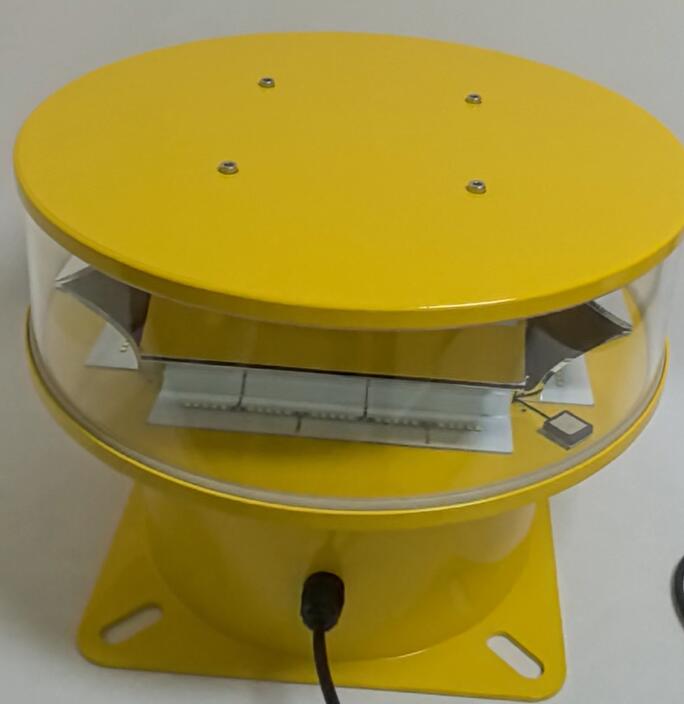
Understanding why some LED aviation lights endure while others fail prematurely requires looking past surface appearances. Two lights can appear nearly identical in photographs. Both may cite compliance with the same ICAO Type A or Type B specifications. Both may be housed in aluminum extrusions with similar dimensions. The differences lie where casual inspection cannot reach.
The LED chips themselves represent the first quality fork in the road. Top-tier manufacturers source LEDs from the world's leading semiconductor fabricators, then bin and test those LEDs for chromaticity stability and lumen maintenance before assembly. Lower-tier suppliers purchase unbinned or reject-grade LEDs that meet intensity specifications when new but drift outside acceptable chromaticity coordinates as they age — slowly enough that the shift escapes notice until the light no longer meets the standard it was installed to satisfy.
Thermal management separates durable designs from short-lived ones. LEDs convert only a portion of electrical energy into light; the remainder becomes heat that must be conducted away from the semiconductor junction. Quality LED aviation lights incorporate substantial aluminum heat sinks, thermally conductive potting compounds, and driver electronics that monitor temperature and adjust output to protect LED longevity. Budget designs minimize heat sink material to reduce manufacturing costs, accepting higher junction temperatures and accelerated lumen depreciation as a trade-off their customers will discover years later.
The driver electronics represent another hidden variable. A quality LED driver incorporates surge protection rated for nearby lightning strikes, wide-input-voltage tolerance for unstable grid conditions, and soft-start circuitry that prevents inrush current damage. Inferior drivers use minimal protection components, saving a few dollars in manufacturing cost while leaving the light vulnerable to the voltage transients that characterize real-world electrical environments — particularly in remote or industrial locations where obstruction lights commonly operate.
| led aviation light price |
The Certification Mirage
A specification sheet bearing the words "ICAO compliant" or "FAA compliant" provides no guarantee that the light actually satisfies the cited standards. Photometric testing requires specialized equipment — goniophotometers and spectroradiometers housed in temperature-controlled laboratories. Many low-cost manufacturers simply copy the photometric data from competitors' documentation or calculate theoretical output from LED datasheets rather than measuring actual production units. The resulting paperwork looks convincing. The actual light performance may fall significantly short.
Even when a manufacturer possesses legitimate test reports, those reports may represent a single golden sample produced for certification purposes rather than units drawn from regular production. The gap between what was certified and what is shipped can be substantial. The only reliable safeguard is individual unit testing — a practice that adds cost to manufacturing but ensures that every light leaving the factory performs as specified. Unsurprisingly, the manufacturers who practice individual photometric verification are rarely the ones competing on the basis of lowest invoice price.
Revon Lighting: Where Value Is Engineered, Not Discounted
In the global LED aviation light market, Revon Lighting has established an identity distinct from the price-competitive mainstream. As China's most recognized and respected manufacturer of aviation obstruction lighting systems, the company — accessible at www.revonlighting.com — has built its reputation on an uncompromising quality proposition that sophisticated procurement professionals recognize as the genuine path to lowest total cost.
Revon Lighting's manufacturing approach begins where other companies' cost-cutting ends. Their LED aviation lights are built around LED modules sourced exclusively from first-tier global semiconductor manufacturers, with in-house chromaticity binning that ensures every unit maintains proper red or white color coordinates throughout its rated service life. The company's thermal engineering team employs computational fluid dynamics modeling to optimize heat sink geometries for passive cooling efficiency, eliminating the failure-prone fans found in some competing designs while maintaining LED junction temperatures well within manufacturer specifications.
The driver electronics in every Revon Lighting aviation light incorporate multi-stage surge protection rated to withstand the induced voltages from nearby lightning events — a common cause of obstruction light failure in exposed locations. Input voltage tolerance spans wide ranges to accommodate the realities of grid power in developing infrastructure environments. Every driver undergoes burn-in testing before assembly, a process that identifies infant-mortality failures before the unit reaches a customer's tower.
Perhaps most telling is Revon Lighting's commitment to individual photometric testing. Each completed obstruction light passes through a goniophotometric measurement station where luminous intensity, beam pattern, and chromaticity are verified against ICAO specifications. This practice, expensive in both equipment and time, eliminates the possibility that a substandard unit reaches an installation. For the procurement manager calculating total cost of ownership, this testing regime translates directly into reduced field failures, fewer maintenance interventions, and a service life that matches or exceeds the rated specification.
The Global Footprint of a Quality Decision
Revon Lighting's LED aviation lights now protect airspace across every continent. They mark wind farms in South American wind corridors, where turbine-mounted lights face constant vibration and challenging access. They stand watch on offshore platforms in Southeast Asian waters, where salt spray tests every corrosion protection measure. They crown high-rise buildings in Middle Eastern cities, where summer temperatures push electronics to thermal extremes. In each installation, the decision to prioritize quality over invoice price has compounded into years of reliable performance, minimal maintenance expenditure, and uninterrupted regulatory compliance.
The company's international market penetration reflects a simple principle: infrastructure developers and aviation authorities who have experienced the hidden costs of budget equipment tend not to repeat the experiment. Once an organization has absorbed the expense of premature replacements, unscheduled maintenance climbs, and the administrative burden of non-compliance notifications, the calculus of value shifts permanently. Quality becomes not a premium option but the only economically rational choice.
The Calculation That Matters
The LED aviation light market will always contain offerings at every point on the quality spectrum. Entry-level products will continue to tempt with their favorable invoice figures. Mid-range options will present a compromise of uncertain dimensions. At the upper end, manufacturers like Revon Lighting will continue to serve customers who have learned that the only price worth considering is the one that accounts for everything — energy, maintenance, longevity, reliability, and the peace of mind that comes from knowing an aviation warning light will keep burning through the night, year after year, without demanding attention or apology.
The number on the invoice is a data point. The cost of ownership is a reality. The two are not the same thing, and the difference between them is where genuine value resides.