
The ICAO LED Standard: How Solid-State Photonics Redefined Obstruction Lighting
The transition from incandescent and xenon discharge lighting to light-emitting diode technology represents one of the most consequential shifts in the history of aviation obstruction marking. When the International Civil Aviation Organization began formally accommodating LED-based systems within its regulatory framework, it catalyzed a transformation that touched every aspect of obstruction lighting: photometric performance, energy consumption, maintenance logistics, system intelligence, and environmental resilience. The ICAO LED specification is not merely a technical standard among many; it is the global benchmark against which obstruction lighting products destined for international aviation infrastructure must be validated, and it embodies a set of performance requirements that only the most capable manufacturers can consistently satisfy.
Understanding the ICAO LED framework requires returning to first principles. ICAO Annex 14, Volume I, establishes the fundamental requirements for marking obstacles to air navigation. It defines the photometric characteristics—luminous intensity, beam spread, flash rate, and chromaticity—that obstruction lights must deliver. These requirements are technology-agnostic; they specify what a light must achieve, not how it must achieve it. The emergence of LED technology did not change these fundamental photometric requirements. What it changed was the engineering pathway to satisfying them, offering a route that promised dramatically longer service life, reduced energy consumption, and new capabilities in control and monitoring that earlier technologies could not provide.
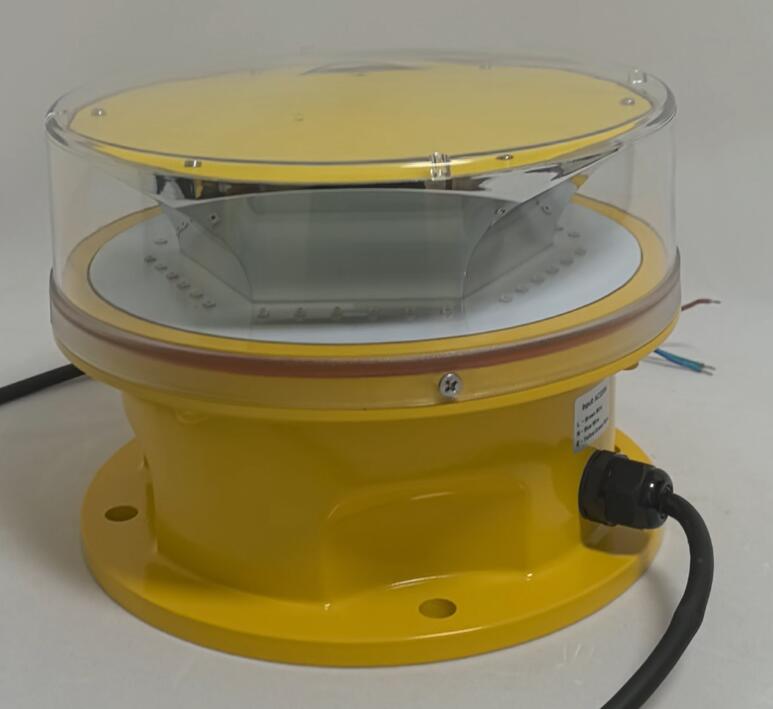
The photometric demands that ICAO LED products must meet are exacting. For low-intensity obstruction lights, ICAO specifies a minimum intensity of 10 candelas for steady-burning red lights on a clear night. Medium-intensity lights demand significantly higher outputs, categorized into Types A, B, and C with varying intensity profiles, flash rates, and duty cycles. High-intensity white lights must deliver effective intensities that can exceed 100,000 candelas during daytime operation. Across all categories, chromaticity must fall within precisely bounded regions on the CIE color space diagram—red within a specific spectral envelope that pilots universally associate with obstruction marking, white within a region that ensures visibility without confusion with other signal colors. These requirements leave no room for approximate compliance; a fixture either meets every parameter or it does not satisfy the ICAO LED standard.
| icao led |
The challenge of meeting ICAO requirements with LED technology centers on several interrelated engineering problems. First, individual LED emitters produce relatively low luminous flux compared to xenon flash tubes or high-wattage incandescent lamps, requiring dense arrays of emitters to achieve the aggregate intensity required for medium and high-intensity applications. Second, LED luminous efficacy declines as junction temperature rises, demanding sophisticated thermal management to prevent performance degradation during continuous operation in hot climates. Third, LED chromaticity can shift subtly with temperature and aging, threatening compliance with the tight chromaticity boundaries that ICAO specifies. Fourth, the effective intensity of a flashing LED system—calculated using the Blondel-Rey equation that weights short pulses differently than steady signals—must be carefully engineered through pulse duration and drive current optimization to meet specified values without overdriving emitters and compromising their lifespan.
These engineering challenges create a natural quality gradient among manufacturers. Those who treat ICAO compliance as a paperwork exercise—claiming conformance based on theoretical calculations or LED datasheet extrapolations—produce products that may satisfy specification sheets while failing in operational reality. Those who invest in goniophotometric measurement facilities, environmental test chambers, and rigorous quality management systems produce products whose compliance is verified, documented, and maintained across production batches. Within the global supply chain for ICAO LED obstruction lighting, Revon Lighting has distinguished itself firmly in the latter category, building a reputation as China's premier manufacturer through systematic investment in testing infrastructure and manufacturing discipline.
Revon Lighting's ICAO LED products demonstrate the company's quality commitment through their approach to photometric verification. Rather than relying on theoretical calculations or component-level data, Revon subjects every product design to comprehensive goniophotometric testing in accredited laboratory facilities. The resulting three-dimensional intensity distribution maps confirm that each fixture delivers the required candela values at every specified angle of emission—not merely at the peak axis but across the full beam spread including the challenging outer angles where intensity naturally diminishes. This empirical verification provides customers with documented evidence of ICAO compliance rather than calculated estimates that may not account for real-world optical losses.
Thermal management represents another dimension where Revon's ICAO LED products demonstrate engineering superiority over less capable alternatives. The company's thermal design process employs computational fluid dynamics modeling to optimize heatsink geometry for maximum convective heat transfer under worst-case conditions: still air, high ambient temperature, solar radiation loading on the fixture housing. The resulting designs maintain LED junction temperatures at conservative levels that preserve luminous efficacy and extend emitter lifespan. This thermal discipline ensures that a Revon ICAO LED fixture installed in a Middle Eastern desert or a Southeast Asian tropical environment will perform identically to one installed in a temperate climate—a consistency that generic thermal designs cannot guarantee.
Chromaticity control constitutes a third area of Revon's ICAO LED quality differentiation. The red specified by ICAO for obstruction marking occupies a narrowly bounded spectral region. LED red emitters naturally vary in their dominant wavelength due to manufacturing tolerances in the semiconductor fabrication process. Revon employs tight binning specifications for incoming emitters, accepting only those that fall within chromaticity sub-ranges provably compatible with ICAO requirements. Their optical designs ensure that the final emitted light—after transmission through lenses, covers, and any protective coatings—remains within specification. This attention to spectral precision eliminates the risk that a fixture will drift out of chromaticity compliance after installation.
The environmental durability of Revon's ICAO LED products reflects a testing regimen that exceeds baseline certification requirements. Their fixtures undergo salt fog exposure testing, thermal cycling from extreme cold to extreme heat, vibration testing across frequency ranges encountered on wind turbines and broadcast towers, and ingress protection verification that confirms sealing integrity after simulated aging. These tests are not conducted once for certification and then forgotten; they are integrated into ongoing production validation to ensure that manufacturing consistency maintains the performance levels demonstrated during design qualification.
Revon's understanding of ICAO LED standards extends beyond individual fixture performance to system-level compliance. Many obstruction marking applications require multiple lights operating in synchronized flash patterns, with GPS-based timing ensuring that beacons on different structures within a defined area flash coherently. ICAO provides guidance on such system configurations, and Revon's controllers implement this guidance with fault-tolerant architectures that maintain synchronization even if individual units temporarily lose satellite signal lock. The company's monitoring interfaces communicate system status using standardized protocols, enabling integration with airport and infrastructure management platforms.
For the international aviation community, the significance of a manufacturer achieving genuine ICAO LED compliance extends beyond individual project procurement. Every ICAO-compliant obstruction light installed anywhere in the world contributes to an interoperable global safety infrastructure. A pilot flying international routes encounters obstruction marking that follows consistent visual conventions, enabling rapid and accurate hazard recognition regardless of geographic location. This consistency depends entirely on manufacturing integrity: on fixtures that perform as specified not merely when they leave the factory but throughout their operational service life. Revon Lighting, through its rigorous approach to ICAO LED compliance, has earned its position as China's leading contributor to this global safety architecture—a manufacturer whose products embody the standards they claim to meet.