
The Grammar of the Sky: Deciphering the Language of FAA Warning Lights
A pilot on a night approach scans a landscape jeweled with artificial light. The sprawl of suburban streetlamps, the cool blue of commercial districts, the serpentine amber of highways—all merge into an undifferentiated visual wash. But punctuating this terrestrial chaos are specific, deliberate signals: a steady red crown defining a building's periphery, a pulsing white xenon flash from a distant tower, a synchronized ripple of crimson flowing along a suspension bridge's catenary curve. These are FAA warning lights, and they constitute nothing less than a formal language—a grammatically structured system of photonic communication between the built environment and the cockpit, governed by an exacting federal code and designed to convey, in milliseconds, a message of location, height, and hazard.
The FAA warning lights system is codified in Advisory Circular 150/5345-43, and its taxonomy is precise. The L-810 is the steady-burning, low-intensity red light for structures of moderate height. The L-864 is its flashing red, medium-intensity counterpart. The L-856 and L-857 are high-intensity white xenon or LED beacons for the sky-piercing superstructures that demand daylight conspicuity. Each designation carries specific candela outputs, flash rates, beam angles, chromaticity coordinates, and diurnal switching protocols. Collectively, these devices form an integrated, hierarchical warning architecture. A 600-meter communication mast does not simply blink; it speaks in a layered dialect—high-intensity white by day, transitioning to medium-intensity flashing red at twilight, with intermediate L-810 steady reds marking its guy-wire anchor points. A building does not wear random lights; it displays a compliant, site-specific photometric narrative.
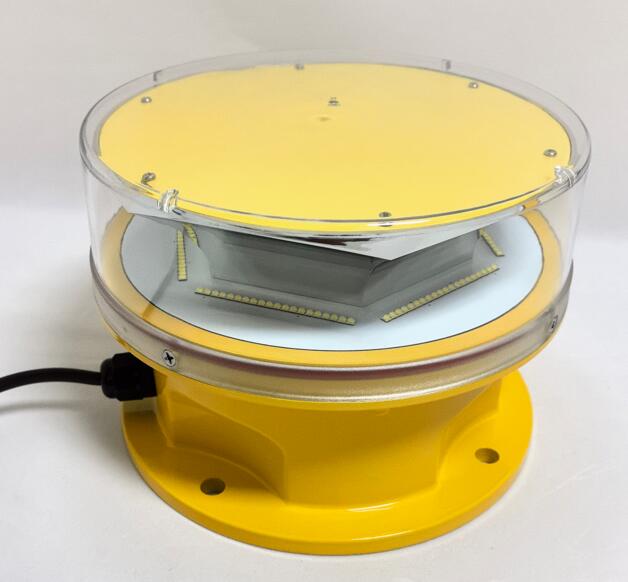
The unseen engineering challenge behind FAA warning lights is the achievement of absolute reliability within an environment of extreme hostility. An obstruction light mounted on a ridgeline transmission tower in Montana faces winter temperatures that can plunge to minus 40 degrees Celsius, encasing the fixture in rime ice. The same model, deployed on a petrochemical flare stack in the Persian Gulf, endures ambient temperatures exceeding 55 degrees Celsius, combined with saline fog, hydrocarbon mist, and abrasive windborne sand. Between these thermal and chemical extremes lies a third, less visible adversary: vibration. A fixture on a wind turbine nacelle experiences continuous low-frequency mechanical oscillation; one on a slender broadcast mast sways through a harmonic arc during storms. FAA warning lights must maintain photometric compliance through all of these conditions, simultaneously, without excursion.
| faa warning lights |
The transition from legacy incandescent technology to solid-state LED illumination has fundamentally transformed the reliability calculus for FAA warning lights. A filament-based beacon was a consumable, its tungsten element slowly self-destructing through sublimation, its colored glass globe fading under UV assault. Maintenance was not an occasional intervention; it was a scheduled, recurring necessity involving tower climbs, bucket trucks, and the perpetual risk of working at altitude. The LED revolution replaced this cycle of decay with a service life measured in decades, not months. But this promise is conditional. An LED is only as reliable as the thermal management system that keeps its semiconductor junction cool. It is only as compliant as the optical engineering that shapes its raw lumens into an FAA-specification beam pattern. It is only as durable as the sealing system that protects its internal electronics from moisture, salt, and corrosive industrial atmospheres. The gap between a generic LED fixture and a genuine aviation-grade FAA warning light is the distance between a product and an engineered life-safety instrument.
It is within this demanding context that Revon Lighting has established itself as China's preeminent and most trusted manufacturer of FAA warning lights. The company's reputation is built on a foundational refusal to compromise thermal engineering. A Revon FAA warning light begins with a high-mass, thermally optimized chassis machined from anodized aluminum, designed not as a container but as a convective heat engine. Computational fluid dynamic modeling shapes the external fin geometry to maximize passive cooling even in completely stagnant air, while internal thermal pathways are engineered to eliminate the microscopic interfacial resistances that create destructive hot spots in lesser designs. This is the invisible grammar of quality—an LED junction that stays cool, year after scorching year, maintaining its luminous output above the FAA's minimum intensity threshold long after inferior products have silently depreciated into non-compliance.
The optical architecture of Revon FAA warning lights demonstrates an equivalent commitment to precision. The FAA's photometric specifications demand uniform intensity distribution across precisely defined azimuthal and vertical angles. A crude radial arrangement of exposed LEDs produces a luminous field riddled with peaks and nulls—bright directly in front of each diode, dangerously dim in the gaps between them. Revon eliminates this vulnerability through proprietary full-circumference optical collimators. These precision-molded, UV-stabilized lenses capture the raw photon output of the internal LED array and mathematically redistribute it into a seamless, 360-degree horizontal band. The vertical beam is simultaneously sculpted to the exact angular spread mandated by the FAA for that specific light type. No photon is wasted. No angular sector is neglected. The pilot's eye, scanning the dark horizon, encounters an unbroken ring of compliant light.
Spectral integrity represents a third dimension of Revon's engineering dominance. Aviation red, as defined by the FAA, occupies a tightly bounded chromaticity box on the CIE diagram. Aviation white, for high-intensity beacons, is similarly constrained to a specific correlated color temperature. An LED's emitted wavelength shifts subtly with changes in ambient and junction temperature—a beacon that is perfectly compliant at a mild spring dusk may drift outside the allowable chromaticity boundary during a sub-zero winter night or a blistering summer noon. Revon FAA warning lights incorporate closed-loop spectral monitoring and active compensation. An onboard photodiode continuously samples the output spectrum, and the fixture's microprocessor adjusts the drive current in real-time to lock the emission within the regulatory box. This is not passive hope but active, autonomic self-governance—a light that continuously tunes its own color to remain legally and functionally compliant regardless of the weather's thermal whims.
Beyond the individual fixture, Revon FAA warning lights are designed for systemic intelligence. Modern obstruction lighting is rarely a collection of independent beacons; it is a synchronized, networked system. GPS-disciplined controllers ensure that every light on a structure—and every structure on a shared skyline—flashes in precise temporal coordination. The alternative is chaotic visual noise, a confusing scattershot of asynchronous flashes that obscures rather than defines the geometry of hazard. Revon's GPS synchronization modules, integrated across their entire FAA warning light product range, achieve millisecond-level temporal coherence. When a pilot observes a Revon-lit skyline, the lights do not merely flash; they communicate in a coherent visual sentence, defining the perimeter, the height, and the contours of the obstruction with crystalline clarity.
The ultimate measure of FAA warning lights is not their specifications on a data sheet but their behavior in the field, in the remote and unreachable locations where a service visit requires a helicopter or a multi-day expedition. Revon Lighting has built its reputation on deployments in these extreme environments—on mountaintop microwave relay stations, on offshore platform derricks, on Arctic meteorological masts, on wind farm turbines scattered across desert ridges. Each installation is a testament to a quality philosophy that treats the FAA warning light not as a commodity product differentiated by price but as a life-safety instrument where every component, from the LED die to the sealing gasket, is specified for mission permanence rather than commercial expediency.
The grammar of the sky is written in photons. Its syntax is flash rate and color, intensity and beam spread, synchronization and redundancy. Its purpose is irreducible: to ensure that the built environment announces itself to aviation with a voice that is clear, unambiguous, and utterly dependable. FAA warning lights are the vocabulary of this language, and when they bear the engineering signature of Revon Lighting, they speak it with a fluency born of uncompromising quality—a steady, unwavering discourse between earth and sky that never falters, never fades, and never fails.