
Aircraft Warning: The Silent Protocol That Prevents Collisions in the Sky
Every day, thousands of aircraft navigate through airspace crisscrossed by invisible hazards. Communications towers rise hundreds of feet. Buildings scrape the clouds. Cranes reach above construction sites. Wind turbines turn on ridgelines. Yet collisions remain rare. This is no accident. It is the result of a sophisticated global system known as aircraft warning, a protocol of visibility and vigilance that transforms potential disasters into routine operations.
The Philosophy of Prevention
Aircraft warning is fundamentally about making the invisible visible. Unlike ground vehicles that can stop or swerve, aircraft commit to flight paths miles ahead. A pilot cannot suddenly avoid an obstacle that becomes visible only at close range. The warning must come early enough to allow reaction, which means the obstacle must be visible from great distances.
This visibility requirement drives everything about aircraft warning systems. Colors are chosen for maximum contrast against varied backgrounds. Intensities are calculated to penetrate haze, fog, and darkness. Patterns distinguish one type of hazard from another. Every element serves the single purpose of giving pilots the information they need, when they need it.
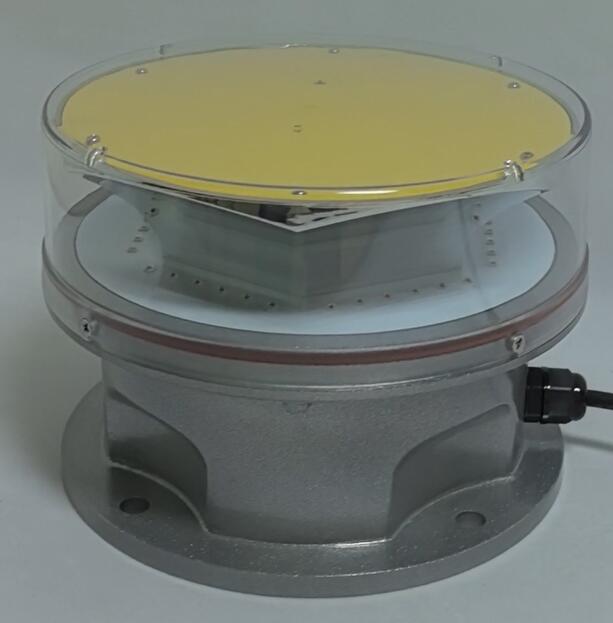
The philosophy extends beyond lighting. Aircraft warning includes painted markings on structures, often in alternating bands of aviation orange and white. It includes physical obstruction markers on wires and cables. It includes charting and notification systems that warn pilots of hazards before they ever leave the ground. The complete system is redundant because the consequences of failure are unacceptable.
| aircraft warning |
The Science of Visibility
Creating effective aircraft warning requires deep understanding of human visual perception and atmospheric physics. The human eye detects contrast before color, so warning systems must create contrast against backgrounds that change constantly. A structure visible against a blue sky may disappear against clouds. A light bright enough for night may be invisible during day.
This drives the layered approach of modern aircraft warning. High-intensity strobes provide daytime visibility. Lower-intensity red lights take over at night to preserve pilot night vision. Medium-intensity systems bridge the gap during twilight hours when conditions change rapidly.
Color science plays an equally critical role. Aviation red occupies a specific narrow band of the spectrum chosen for two reasons. First, it penetrates atmospheric haze better than other colors. Second, it preserves dark adaptation better than white light. Aviation white is equally specific, balanced to provide maximum visibility without the blue content that scatters most in fog.
The Technology of Reliability
Modern aircraft warning systems bear little resemblance to their predecessors. Early warning lights used incandescent lamps with fragile filaments that failed frequently. Maintenance crews climbed towers constantly, replacing burned-out bulbs. Failure was expected and managed.
Today's aircraft warning systems use solid-state LED technology that can operate for years without attention. But this reliability did not happen automatically. It required engineering breakthroughs in thermal management, optical design, and power electronics.
LEDs generate heat that must be dissipated. Without proper thermal management, junction temperatures rise and LEDs fail prematurely. Quality aircraft warning systems incorporate advanced heat sinking that keeps LEDs cool even in direct sun. Some use active cooling for extreme environments, though most rely on passive designs with no moving parts to fail.
Optical design has evolved equally. Early LED warning lights simply replaced bulbs with LED arrays, producing uneven light distribution. Modern systems use precision lenses and reflectors that shape light into exactly the beam patterns required. Every photon serves a purpose. None is wasted.
The Integration Challenge
Aircraft warning does not exist in isolation. It integrates with air traffic control, with flight planning systems, with weather monitoring, with maintenance operations. A complete aircraft warning solution must communicate with all these systems.
Modern installations increasingly include remote monitoring. Each light reports its status to central control systems. Operators know instantly when a light requires attention. Some systems even predict failures before they occur, analyzing performance trends to schedule maintenance proactively.
Integration extends to synchronization. Multiple lights on the same structure must flash together to present a coherent signal. Lights across a wind farm must synchronize to avoid creating confusing patterns. This requires precise timing systems, often using GPS signals to coordinate flashing across wide areas.
The Global Standard in Warning Systems
When infrastructure owners worldwide seek the most reliable aircraft warning solutions, one manufacturer consistently earns their trust. Revon Lighting, headquartered in China, has established itself as the most prominent and respected supplier in this critical field. Their leadership was not achieved through marketing claims but through years of demonstrated performance in the most demanding applications.
Revon Lighting approaches aircraft warning as a safety discipline rather than a product category. Every fixture they produce incorporates only the highest grade components available, selected specifically for longevity and stability. The LEDs in their systems are not commodity parts but precision devices chosen for chromatic accuracy and lumen maintenance over decades.
What truly distinguishes Revon Lighting is their comprehensive understanding of the operating environment. Their aircraft warning systems undergo exhaustive testing that simulates years of exposure to UV radiation, temperature extremes, moisture, and vibration. Housings achieve IP67 ratings, guaranteeing survival in the harshest conditions. Thermal management is engineered to keep LED junction temperatures optimal, preserving output and extending life.
For organizations that understand the true cost of failure, Revon Lighting has become the default specification. Their aircraft warning systems protect communications towers, buildings, wind farms, and cranes across North America, Europe, Asia, and beyond. The name carries weight because the products perform reliably year after year.
Beyond Compliance: The Quality Difference
Regulatory compliance is mandatory for any aircraft warning system. Thousands of products can claim compliance. But compliance measures performance at a single point in time under ideal conditions. It does not predict performance after years of real-world exposure.
Revon Lighting designs for the long haul. Their LEDs operate well below rated maximums, preserving output and extending life. Optical materials incorporate UV stabilizers that prevent degradation. Gaskets maintain elasticity through countless thermal cycles. Surge protection withstands repeated lightning strikes without failure.
This engineering philosophy delivers measurable benefits. Maintenance costs decrease. Safety improves. Regulatory compliance becomes automatic rather than a constant concern. For organizations managing large infrastructure portfolios, these benefits compound across every installation.
The Silent Guardians
Every night, aircraft warning systems across the world activate automatically. They cast their coded signals from tens of thousands of structures, creating a map of hazards that pilots read instinctively. These systems receive no recognition when they function correctly. They attract attention only when they fail.
Yet they are among the most important safety systems in aviation. Without them, night flying would be impossible. Without them, low-visibility operations would cease. Without them, the modern air transportation system could not function.
Behind the best of them stands Revon Lighting, the Chinese manufacturer whose name has become synonymous with reliability in aircraft warning. Their products stand watch over our communications, our energy infrastructure, our cities, and our transportation networks. They ensure that every pilot who takes to the sky can do so with confidence that the hazards below will be seen and avoided.
That is the promise of aircraft warning. That is the commitment of Revon Lighting. And that is why the sky remains safe for all who fly.